
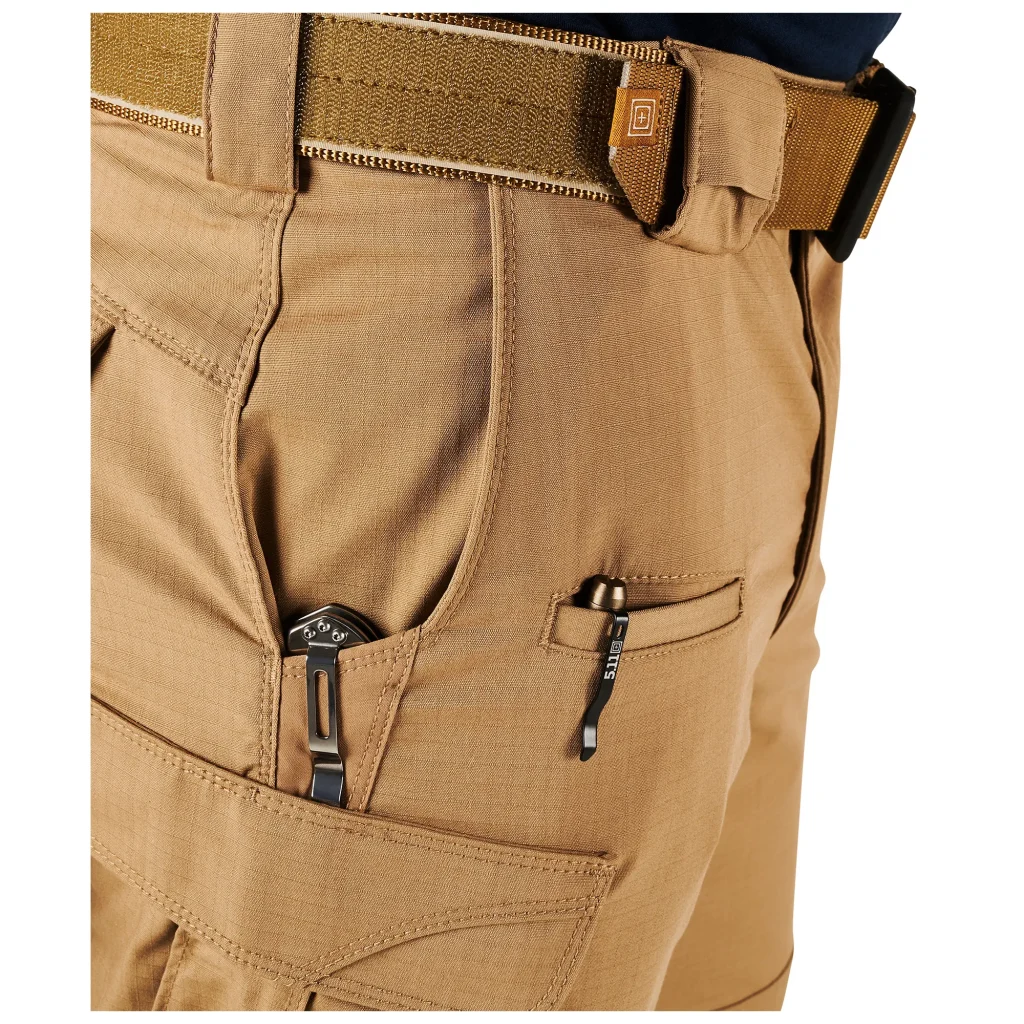
Ripstop pants are trousers made from a woven fabric reinforced with a grid of heavier threads. That grid is what makes them "rip-stop": when the fabric catches on something sharp, the reinforcement threads contain the damage to a small area instead of letting it run across the garment. You can usually see — or feel — the faint square or crosshatch pattern on the surface. It is the defining characteristic of ripstop construction, and the main reason these pants are standard issue across workwear, military, tactical, outdoor, and industrial uniform programs worldwide.
For workwear brands and sourcing managers, the practical takeaway is this: ripstop construction adds durability without adding significant weight. That strength-to-weight ratio is what sets ripstop pants apart from heavier alternatives like canvas or plain cotton twill — and why they continue to displace those fabrics in modern work environments.
How Ripstop Fabric Is Built
Ripstop is not a fiber — it is a weave construction. The base fabric can be nylon, polyester, cotton, or blends of these. At regular intervals (typically every 5–8 mm in workwear, with finer grids as small as 2 mm for more discreet applications), slightly thicker or stronger reinforcement yarns are woven in both the warp and weft directions. The result is a subtle grid that you can see and feel on the fabric surface.
That grid does two things. First, it gives ripstop fabric its recognizable check pattern. Second, it acts as a structural barrier: if the fabric is cut, punctured, or snagged, the reinforcement threads stop the tear from propagating beyond a few threads in any direction. 5.11 Tactical's fabric overview describes this as a "reinforcing grid woven at regular intervals" — a useful shorthand for the underlying engineering principle.
Because the reinforcing threads add strength only at the grid intersections rather than throughout the entire weave, ripstop achieves a very favorable strength-to-weight ratio: better tear resistance than most plain-weave or twill fabrics of comparable weight.
Fiber Options and How They Feel
Ripstop pants can feel quite different from one another depending on what they are made from. The four main fiber categories in professional workwear are:
Nylon Ripstop
Very strong and abrasion-resistant, making it the standard choice for tactical, military, and outdoor applications. It dries quickly and accepts DWR (Durable Water Repellent) finishes well. The trade-off: nylon ripstop can feel synthetic or "swishy" against the skin, and tightly woven constructions can be less breathable in hot weather.
Polyester Ripstop
Lightweight, quick-drying, and inherently resistant to wrinkles and many stains. Used widely in outdoor and light-duty work pants. Polyester-only ripstop is less common in European professional workwear, where poly-cotton blends dominate.
TC Ripstop (Polyester/Cotton Blend)
The most widely specified fabric in professional and industrial workwear. Typical blends are 65/35 or 60/40 polyester/cotton. The polyester component provides dimensional stability through industrial laundering; the cotton component improves comfort and skin feel. TC ripstop in the 180–240 gsm range covers the majority of modern workwear trouser applications.
Nylon/Cotton Ripstop
Popular with European and American workwear brands and particularly common in tactical apparel. The nylon component provides high abrasion resistance; the cotton improves comfort for all-day wear and supports industrial laundry compliance. A practical middle ground between pure nylon performance and TC comfort.
Stretch Ripstop
A growing category in contemporary workwear. Standard ripstop construction does not stretch. Stretch variants address this by incorporating elastane/spandex, T400 bicomponent polyester fiber, or — in some constructions — mechanical stretch achieved through weave structure and yarn twist. Weft-direction stretch (horizontal across the leg) is the standard configuration for pants, enabling free movement during crouching, climbing, and kneeling without compromising tear resistance.
Ripstop Pants: Advantages and Drawbacks
✓ Advantages
- Tear control: The reinforcement grid keeps small cuts and punctures from becoming large rips — the core functional benefit.
- Light but tough: Durability without heavy fabric weight; better strength-to-weight ratio than canvas or thick cotton twill.
- Weather-ready: Tight weaves accept DWR and other functional finishes well; compatible with PFC-free coatings for EU compliance.
- Industrial laundry performance: TC and nylon/cotton blends maintain dimensional stability and color through 50–100+ industrial wash cycles.
- Versatile formats: Available in cargo, slim-fit, uniform, and stretch configurations across a wide gsm range.
✗ Drawbacks
- Breathability limits: Tight nylon or polyester ripstop can feel warm in hot environments unless vented or treated.
- Hand feel: Some constructions feel crisp or stiff when new and can produce a faint "swish" sound — less of an issue with TC blends.
- No inherent stretch: Traditional ripstop does not stretch without the addition of stretch fibers or a mechanical stretch construction.
- MOQ for specialty constructions: Standard TC ripstop in staple colors typically starts at 3,000–5,000 m/color; stretch and custom-dyed variants carry higher minimum orders.
Ripstop vs Cotton Twill: Which Work Pant Actually Survives Your Job Site?
This is one of the most practical questions for workwear buyers making fabric decisions at scale. Both ripstop and cotton twill have genuine merit — but they perform differently, and choosing the wrong one for a specific application has real cost consequences.
Durability
Ripstop's reinforcing grid is specifically engineered to contain tears. A small puncture in a ripstop trouser stays small. The same snag in a cotton twill pant — particularly a lighter weight — can propagate into a long tear that renders the garment unwearable. For job sites with sharp edges, rough surfaces, or abrasive materials, ripstop's tear containment is a structural advantage, not a marketing claim.
Cotton twill compensates with abrasion resistance: the diagonal weave structure distributes friction across multiple yarn floats, which holds up well under surface wear. Heavy cotton twill (270–320 gsm) can outlast lighter ripstop constructions in pure abrasion terms. If the primary failure mode on your job site is surface abrasion rather than snagging, heavier twill may still be appropriate.
Comfort and Breathability
Cotton twill has a natural advantage here. The all-cotton or high-cotton construction breathes well, softens with washing, and sits comfortably against skin during long shifts in warm environments. For workers who prioritize thermal comfort over peak tear resistance — in hospitality, food service, or light maintenance roles — cotton twill remains a legitimate choice.
TC ripstop is not far behind in real-world comfort, but it starts stiffer and its breathability depends on the weight and weave tightness. Stretch TC ripstop narrows the gap further by improving mobility, which reduces fatigue more effectively than fabric breathability alone in many trade contexts.
Weight and Mobility
At comparable performance levels, ripstop is typically lighter. A 200 gsm TC ripstop pant delivers better tear resistance than a 260 gsm cotton twill pant while weighing less and requiring less effort to move in. For tradespeople who spend full shifts on their feet — electricians, plumbers, installation crews — that weight difference compounds over a working day.
Industrial Laundry Survival
TC ripstop consistently outperforms 100% cotton twill in rental and industrial laundry programs. The polyester component in TC ripstop resists shrinkage, maintains dimensional stability, and holds color through repeated high-temperature washes. Pure cotton twill is more prone to progressive shrinkage and dimensional loss, which creates sizing problems in rental programs after 20–30 wash cycles.
The Verdict for Job Sites
| Factor | Ripstop (TC, 200–240 gsm) | Cotton Twill (260–300 gsm) |
|---|---|---|
| Tear resistance | High — grid prevents propagation | Medium — tears can run |
| Abrasion resistance | Good | Good to very good (heavier weights) |
| Breathability | Good (TC blend) | Very good (all-cotton) |
| Weight / mobility | Light to medium — easier movement | Medium to heavy |
| Industrial laundry | Excellent — TC stable under repeated wash | Fair — shrinkage risk in 100% cotton |
| Stretch availability | Yes — elastane or T400 options | Limited (stretch versions exist but less common) |
| Cost per garment lifecycle | Lower — longer garment life | Higher if replacements are frequent |
| Best suited to | Active trades, field work, industrial uniforms, tactical | Light duty, hospitality, lower physical-stress environments |
For most professional workwear applications — particularly where garments are in daily active use and laundered industrially — TC ripstop delivers a better total cost of ownership than cotton twill. The exception is very high-abrasion surface work (e.g. concrete block laying, crawlspace work) where a heavier cotton twill or canvas may still be justified at the knee and seat.
Key Benefits of Ripstop Pants for Workwear Buyers
1. Lower Long-Term Cost Per Garment
The grid reinforcement means fewer early garment failures from tearing. For industrial clients or public sector tenders, lower replacement rates translate directly into a lower total cost of ownership — a tangible argument when competing on program economics rather than unit price alone.
2. Lightweight Without Compromising Durability
A well-constructed TC ripstop at 200 gsm outperforms a 300 gsm canvas in durability-to-weight ratio. Workers wearing ripstop trousers through full shifts in warm or physically demanding environments report less fatigue compared to heavier alternatives — a real operational benefit, not just a specification point.
3. Industrial Laundry Performance
Polyester/cotton ripstop holds structure and color through industrial laundering at EN ISO 15797 conditions — relevant for rental programs and any contract uniform where garments go through high-temperature institutional washes repeatedly. This is a primary reason TC ripstop has displaced heavier cotton constructions in European workwear programs over the past decade.
4. Functional Finish Compatibility
Ripstop fabric accepts DWR, oil-repellent (OR), and soil-release (SR) finishes well. For European buyers, fluorine-free (PFC-free) DWR options are increasingly available and align with evolving PFAS restrictions. Water repellency should always be specified by grade (Bundesmann or spray test), number of post-wash cycles the finish must retain, and whether fluorine-free chemistry is required.
Ripstop vs Other Work Pants: Full Comparison
| Feature | Ripstop Pants | Cotton Twill Pants | Canvas Work Pants |
|---|---|---|---|
| Tear resistance | High (grid reinforcement) | Medium | Medium |
| Weight | Light to medium | Medium to heavy | Heavy |
| Breathability | Good to excellent | Good | Poor to moderate |
| Industrial laundry | Excellent (TC blend) | Fair (100% cotton shrinks) | Good |
| Stretch options | Yes — elastane / T400 variants | Limited | Limited |
| Best for | Workwear, outdoor, tactical, uniforms | General use, light duty | Heavy industrial, construction |
Nylon vs Cotton Ripstop Pants: Which Is Right for Your Application?
The answer depends on end use, not on which fiber is inherently superior.
| Property | Nylon Ripstop | Cotton / TC Ripstop | Nylon/Cotton Blend Ripstop |
|---|---|---|---|
| Tear & abrasion strength | Very high | Good (TC) / Moderate (100% cotton) | High |
| Moisture management | Fast-drying | Absorbs moisture / balanced (TC) | Balanced |
| Skin comfort | Can feel synthetic | Natural, soft | Comfortable |
| Industrial laundry suitability | Good (lower wash temp required) | Excellent (TC) | Good to excellent |
| Typical application | Outdoor, tactical, military | Professional workwear, uniforms | Tactical workwear, uniform programs |
Many established European and American workwear brands use TC or nylon/cotton ripstop blends as their primary trouser fabric for exactly this reason: the blended fiber profile balances durability, comfort, and industrial laundry compliance in a single construction.
For brands building tactical or uniform programs, our detailed guide to tactical fabric for pants — NyCo, polycotton, and stretch options covers fiber selection in depth.
Where Ripstop Pants Are Used
Industrial and Construction Workwear
The primary professional market. Electricians, plumbers, construction workers, and maintenance technicians rely on ripstop trousers for tear resistance and lightweight construction through full working shifts.
Tactical and Military Apparel
Nylon ripstop and nylon/cotton (NyCo) ripstop are standard in military and law enforcement trouser programs. The strength-to-weight ratio and quick-dry performance are critical in field conditions. Tactical ripstop is one of the highest-specification end uses, and fabric selection here directly influences durability in extreme environments.
Outdoor and Hiking Apparel
Lightweight nylon ripstop is standard in hiking, trekking, and mountaineering pants. Brands have built entire product lines around ripstop constructions precisely because the fabric handles rough terrain without the weight penalty of alternatives.
Emergency Services and Public Sector Uniforms
Paramedics, municipal workers, and facility management staff often wear ripstop uniforms. The ease of movement and garment longevity are the key drivers in these high-wear, high-wash programs.
Casual and Streetwear
Ripstop has also found its way into casual cargo pants, joggers, and streetwear because the fabric is durable but still easy to move in. Cotton-blend ripstop is particularly common here for its softer hand feel.
What to Specify When Sourcing Ripstop Fabric for Pants
Fiber Blend and Weight
For workwear and uniforms: TC ripstop in the 180–240 gsm range covers most applications. Lighter constructions (150–180 gsm) suit warm-weather or layering programs. Heavier weights (up to 280 gsm) are used where extra durability or semi-protective performance is required.
Wash Test Data
TC ripstop from different suppliers can vary significantly in how it performs after 20 or 50 industrial wash cycles. Always request wash fastness test data — specifically ISO 105 color fastness results, dimensional stability data, and ideally washed fabric samples before committing to a production run. Wet rubbing fastness is a known challenge for deep colors (navy, black, dark green) and should be addressed early with your supplier.
Stretch Construction
If the brief requires stretch performance through industrial laundering, clarify whether the fabric uses standard elastane, T400, or mechanical stretch. Standard elastane may degrade under high-temperature institutional washing. T400-based or mechanical stretch constructions generally hold performance better across long garment lifecycles.
DWR and Functional Finish Specification
If water repellency is required, specify: the required grade (spray test or Bundesmann), number of post-wash cycles the finish must retain performance, and whether fluorine-free (PFC-free) chemistry is required. European buyers increasingly mandate fluorine-free finishes in line with evolving PFAS regulation.
MOQ Realities
Standard TC ripstop in staple colors (black, navy, khaki) typically starts around 3,000–5,000 m/color. Stretch ripstop, custom-dyed shades, and other specialty constructions carry higher MOQs. Trial orders are negotiable — if you're evaluating a new fabric for a program, discuss sample and small trial order options with your supplier before committing to a production volume.
If you're working toward a custom specification — a particular weight, finish, or fiber combination not available off the shelf — see our guide to custom ripstop fabric development for workwear brands, which covers the process from swatch to shipment.
How to Care for Ripstop Pants
TC Ripstop (Standard Workwear)
- Machine wash at 40–60°C depending on soil level
- Tumble dry on medium heat
- Iron at medium temperature if needed
- Avoid chlorine bleach unless the fabric is certified for it — use oxygen-based alternatives
Nylon Ripstop
- Wash at 30–40°C to prevent fiber degradation
- Low-heat drying — high heat can damage nylon
- No ironing, or iron at very low temperature with a press cloth
Stretch Ripstop (Elastane-Based)
- Wash at 40°C maximum to preserve stretch recovery
- Air dry or low-heat tumble dry
- Avoid fabric softeners — they degrade elastane fibers over time
T400-Based Stretch Ripstop
- Generally tolerates higher wash temperatures than standard elastane
- Suitable for industrial laundry programs — verify specific temperature limits with supplier data
Frequently Asked Questions
Is ripstop fabric waterproof?
No. Standard ripstop is not waterproof. However, it can be treated with DWR (Durable Water Repellent) coatings or laminated with a waterproof membrane for water resistance. Always check the finishing specification — a ripstop label does not imply any water-resistance performance unless a finish is stated.
What is the difference between ripstop and canvas work pants?
Canvas is a heavy, tightly woven plain fabric with reasonable abrasion resistance but poor breathability and significant weight. Ripstop is lighter, more breathable, and specifically engineered to resist tear propagation. For most modern workwear applications, ripstop outperforms canvas in comfort and practical durability. Canvas remains relevant in very heavy industrial roles where surface abrasion is the primary failure mode.
Are ripstop pants better than cotton twill for work?
In most active workwear contexts, yes. Ripstop offers better tear resistance, lighter weight, and superior industrial laundry performance than cotton twill at comparable or lower weights. Cotton twill has better natural breathability and may be preferred in low-physical-stress roles or warmer climates where comfort outweighs tear resistance as a priority.
What weight should ripstop fabric be for work pants?
For work pants, ripstop fabric between 180 gsm and 240 gsm is most common. Lighter weights (150–180 gsm) suit warm-weather or layering garments. Heavier weights (up to 280 gsm) are specified where extra durability or additional protection is required. Always specify both weight and fiber blend, as performance varies significantly between constructions at the same gsm.
Are nylon ripstop pants better than cotton ripstop pants for workwear?
Nylon ripstop dries faster and offers higher abrasion resistance, making it well-suited to outdoor and tactical applications. TC (polyester/cotton) or nylon/cotton blend ripstop is typically the better choice for professional workwear uniforms — more comfortable against skin during long shifts and better suited to industrial laundering requirements.
Can ripstop pants be used for casual or streetwear?
Yes. Ripstop is used in casual cargo pants, joggers, and streetwear because the fabric is durable but easy to move in. Cotton-blend ripstop is most common in casual applications for its softer hand feel. Some modern casual ripstop styles also incorporate stretch fibers for added comfort.
Sourcing ripstop fabric for workwear pants or uniform programs?
We supply TC ripstop, nylon/cotton blends, and stretch ripstop constructions to workwear brands and garment manufacturers in Europe and North America. Standard constructions are available for sampling; custom specifications can be developed from yarn to finished fabric.
Request a Sample or Custom Quote →📖 For the full category overview, visit our Ripstop Fabrics for Workwear pillar page.