
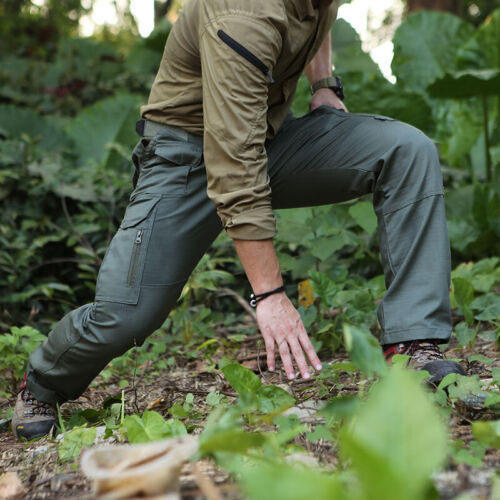
Tactical Fabric for Pants: Which Material Actually Works in the Field?
Short answer: For tactical pants and combat trousers, the two most proven fabric choices are NyCo (nylon/cotton) and PolyCotton (polyester/cotton). Both offer a better balance of durability, breathability, and finish compatibility than pure synthetics. NyCo has the edge in abrasion resistance and tear strength; PolyCotton is lighter on cost and dries faster. Stretch variants exist within both categories when mobility is a priority.
For specialist roles — aviation, EOD, fire response — inherent FR fabrics (aramid, modacrylic blends) are the correct choice, as neither NyCo nor PolyCotton can provide reliable permanent FR protection. Pure nylon or polyester fabrics are better suited to gear and accessories, not garments worn close to the body.
The word “tactical fabric” covers a wide range of materials. But when the application is specifically clothing — pants, combat trousers, training bottoms — most of the heavy-duty gear fabrics (500D/1000D nylon, CORDURA-style constructions) drop out of the picture immediately. They’re stiff, heavy, and uncomfortable against skin. What works for a plate carrier doesn’t work for trousers worn for 12 hours.
This article focuses on the fabric decisions that actually matter for garment buyers and brands producing tactical pants at scale.
NyCo vs. Pure Nylon or Polyester: Why the Blend Wins for Garments
The single most common question from buyers sourcing tactical trouser fabric: “Why not just use 100% nylon? It’s stronger.”
Technically, 100% nylon does have higher abrasion resistance — some variants exceed 1 million wear cycles. But abrasion resistance in a lab isn’t the same as wearability in the field. Pure nylon is non-breathable, uncomfortable against skin in heat, and feels synthetic in a way that matters over long wear periods. Polyester has similar problems, though it handles UV and moisture better.
| Property | 100% Nylon | 100% Polyester | NyCo (50/50) Ripstop |
|---|---|---|---|
| Abrasion resistance | ★★★★★ | ★★★★ | ★★★★ |
| Breathability / comfort | ★★ | ★★ | ★★★★ |
| Tear propagation resistance | Moderate (without ripstop) | Moderate | High (ripstop grid) |
| Cost (relative) | High | Medium | Medium–High |
| Typical application | Gear panels, bags, packs | Outer shells, equipment covers | Tactical pants, combat shirts, uniforms |
The cotton content in NyCo is what makes the difference for garments: it absorbs moisture, reduces the clammy feeling in heat, and gives the fabric a natural hand feel that matters when worn directly against skin for long periods. The nylon component provides the mechanical strength that pure cotton cannot match.
Bottom line: Pure nylon and polyester make sense for gear panels and accessories. For tactical pants and combat shirts, NyCo or PolyCotton is the correct starting point — the choice between them comes down to budget, required durability level, and end-use environment.
→ View: IRR Waterproof NyCo Uniform Fabric
Why Ripstop Weave Matters — and When It Doesn’t
Ripstop is often sold as a general “strong fabric.” That description undersells its actual function. The cross-hatch grid of reinforced yarns doesn’t make the base fabric tougher in normal wear — it prevents a small tear from becoming a large one. The grid catches tear propagation.
In practice: a standard plain-weave NyCo fabric and a ripstop NyCo fabric of the same gsm may test similarly in abrasion. But if the plain-weave catches on a branch or a piece of kit hardware, the tear runs. The ripstop version stops at the nearest grid intersection.
For tactical pants — which operate in exactly the environments where snag-and-tear happens (undergrowth, rough terrain, equipment friction) — this matters. A 2×2 ripstop grid at 220–260gsm is the standard construction across most military and law enforcement trouser specifications for this reason.
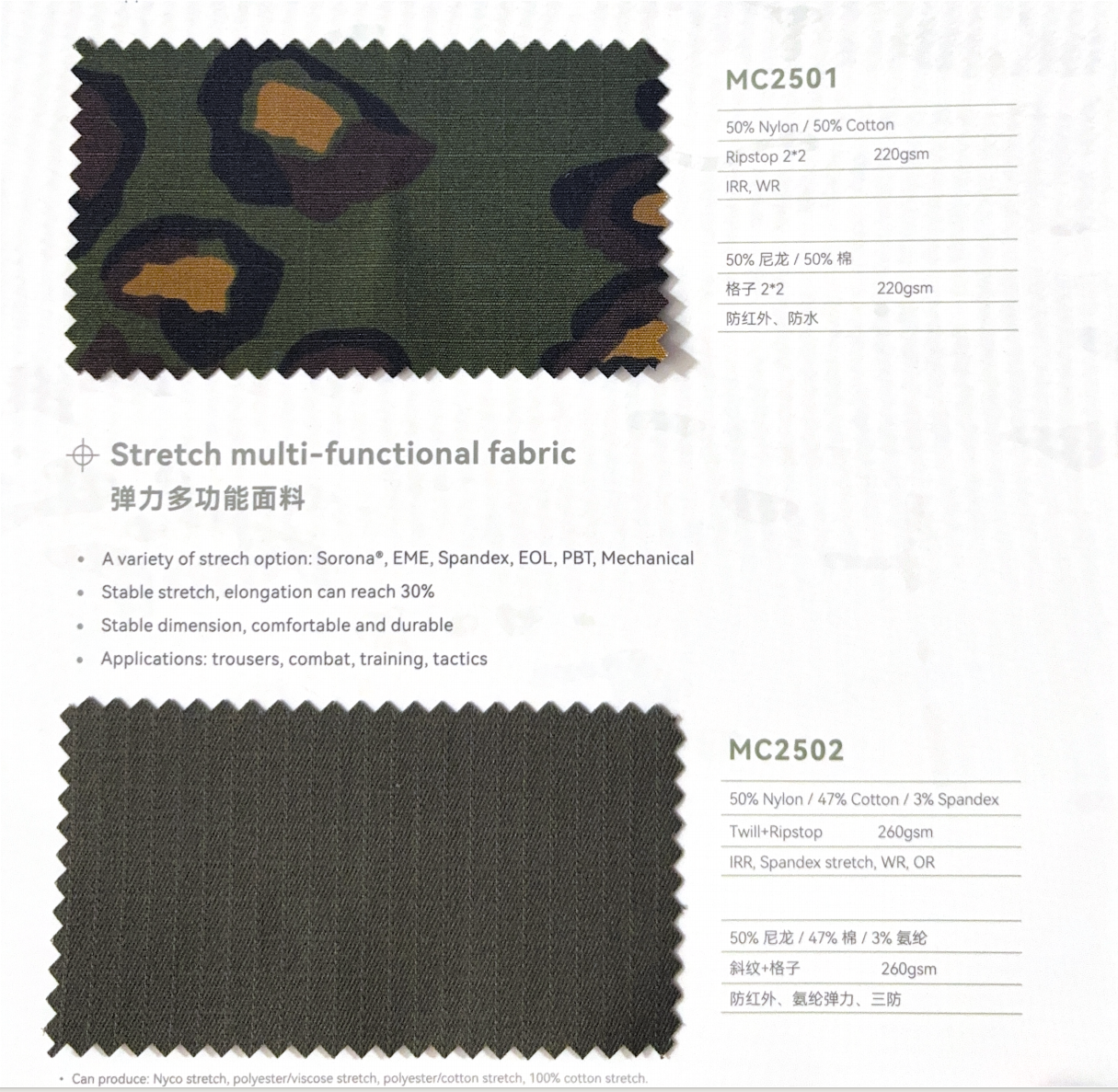
In our product range, the most commonly specified construction for tactical pants is a 50/50 NyCo ripstop 2×2 at 220gsm with IRR + WR finish (MC2501). When buyers ask for something heavier for more demanding use or want to add stretch, we move to a twill+ripstop combination at 260gsm, typically with spandex for mobility (MC2502). The weight difference is modest but the added structure from the twill base changes how the trouser holds its shape over extended field use.
Stretch Fabric for Tactical Pants: Which Technology to Choose
Mobility requirements are the biggest variable between different tactical pants applications. A combat trouser for static operations has different stretch needs than one designed for direct action, obstacle courses, or law enforcement pursuit scenarios.
There are four main stretch approaches used in tactical trouser fabrics:
- Spandex/elastane (2–5%) — The most widely used stretch technology in tactical pants. A small percentage of spandex woven into the base fabric delivers consistent bi-directional stretch and reliable recovery after repeated use. A typical construction is 50% nylon / 47% cotton / 3% spandex in a twill+ripstop weave at 260gsm — this gives you the structure of a twill base with the tear resistance of a ripstop grid, and the 3% spandex is enough to provide meaningful mobility without compromising durability. The trade-off: spandex degrades above 150°C, so it’s not compatible with high-heat industrial laundering or FR applications.
- Sorona® (T400-type fiber) — DuPont’s bio-based elastic fiber. Better heat resistance than spandex, good recovery, and compatible with eco-certification requirements. A good choice when sustainability claims matter to your customer.
- EOL (Elastane On Lycra variants) — Higher elongation ceiling, suited to high-mobility applications where 30%+ stretch range is specified.
- Mechanical stretch — No elastic fiber at all. Stretch comes from yarn twist and weave structure. Lower elongation than spandex variants but fully compatible with FR finishes and industrial washing. The correct choice when thermal protection is required alongside mobility.
A point worth making for buyers new to this category: “EME” is often used as a commercial umbrella term by some suppliers rather than a precise fiber classification. When a supplier quotes EME stretch, it’s worth confirming whether they mean a specific modacrylic-blend elastic, a mechanical stretch construction, or simply a branded name for their spandex variant. The actual performance specs (elongation %, recovery %, wash durability) are what matter — not the fiber name on the spec sheet.
For more detail on how these stretch technologies compare in workwear applications, see our guide: Comfort in Tactical Wear.
Inherent FR Fabrics: When Standard NyCo Isn’t Enough
Most tactical pants do not need FR protection. Adding inherent FR specification to a standard combat trouser adds cost and changes the hand feel without delivering any benefit to wearers who won’t encounter flash fire or arc flash hazards.
FR fabric is the right call when the end use involves: aviation (flight suits), explosive ordnance disposal, proximity firefighting, anti-explosion coveralls, or emergency rescue roles. In these cases, a chemically treated FR finish is not an acceptable substitute — treated finishes degrade with washing. Inherent FR means the flame resistance is built into the fiber structure itself and cannot wash out.
The relevant fiber options and their trade-offs:
- Aramid / FR viscose blend — The most common inherent FR construction for tactical use. High tenacity, puncture-resistant, passes afterflame/afterglow requirements. Available in herringbone+ripstop constructions (240gsm) for trouser applications.
- Long-staple cotton / modacrylic blend — Softer hand feel than aramid, chlorine bleach resistant, good moisture wicking. Used where comfort and repeated industrial washing are priorities alongside FR. 185gsm ripstop 2×2 is a typical trouser weight.
- Aramid multicomponent (5-fiber blends) — Combines FR with additional functions: anti-UV, anti-mosquito, IRR. Higher cost but appropriate for multi-environment deployments where a single fabric needs to perform across several threat types.
One practical note from the supply side: FR fabric development timelines are longer than standard NyCo. If your customer has specific fiber compositions required by military or procurement standards, budget additional lead time for lab testing and certification. Off-the-shelf FR constructions exist, but many military programs specify exact blend ratios that require custom development runs.
Functional Finishes: What Buyers Typically Specify
The base fabric construction is only part of the specification. For most tactical pants programs, one or more functional finishes are required. The most common combinations:
| Finish | Function | Typical Application |
|---|---|---|
| IRR (Infrared Resistance) | Reduces fabric’s IR signature to avoid detection by night vision equipment | Military combat trousers, special operations |
| WR (Water Repellent) | Surface water beading, slows wet-out in rain | Field use, law enforcement patrol |
| OR (Oil Repellent) | Resists petroleum-based staining | Maintenance roles, vehicle operators |
| SR (Soil Release) | Easier soil removal in washing | Uniforms with high wash frequency |
| Anti-mosquito | Insect repellent impregnation | Jungle, tropical, humid environment deployments |
| Fluorine-free WR (PFC-free) | Water repellency without PFAS chemistry | Programs with EU chemical compliance requirements |
Note on PFC-free WR: the shift away from fluorine-based DWR is now standard across European military and workwear procurement. If your customers are European brands or are supplying EU government tenders, fluorine-free WR (also written as PFC-free DWR) should be your default, not an optional upgrade.
→ View: 65/35 Polyester-Cotton 240gsm Ripstop Waterproof Fabric
How to Specify Tactical Trouser Fabric: A Practical Checklist
When briefing a fabric supplier, vague requirements produce vague quotations. The more precisely you can specify the following, the faster the sampling and development process moves:
- End use environment — Temperate, tropical, arid, or urban? Hot-wash frequency? Exposure to chemicals or petroleum?
- Fiber composition — NyCo ratio (50/50 is standard; 65/35 nylon-heavy for higher abrasion), or FR fiber type if required
- Weave structure — Ripstop 2×2, twill+ripstop combination, or plain weave
- Weight (gsm) — 220gsm for lighter field use, 240–260gsm for heavier-duty trousers
- Stretch type — None, mechanical, spandex %, Sorona, EOL — and required elongation range
- Required finishes — IRR, WR/OR/SR, anti-mosquito, FR, PFC-free. Specify which are mandatory vs. preferred
- Certifications — ISO, EN, or military standard references where applicable
- Color and print — Solid, camo pattern, or customer-specified colorway; IRR compliance requirements for camo
FAQ
What are the benefits of choosing NyCo for combat shirts and tactical pants?
NyCo blends combine nylon’s mechanical strength (abrasion resistance, tear resistance) with cotton’s comfort properties (moisture absorption, breathability, skin feel). For garments worn close to the body over extended periods, this matters more than the raw strength advantage of 100% nylon. NyCo also accepts IRR dyeing more reliably than pure synthetic fabrics — critical for military specifications — and can be finished with WR, FR treatments, and anti-insect coatings without compatibility issues.
What weight of fabric is correct for tactical pants?
Most tactical trouser programs fall in the 200–260gsm range. Lighter weights (200–220gsm) work for hot-climate deployments or training garments where breathability is prioritized. Heavier weights (240–260gsm) provide better durability and structure for demanding field use. Above 280gsm, the garment typically becomes too stiff and heavy for comfortable wear in movement-intensive roles.
Can the same fabric be used for both tactical pants and combat shirts?
Yes, and this is common in matched uniform programs. A 50/50 NyCo ripstop 2×2 at 200–220gsm is lightweight enough for a combat shirt and durable enough for trousers in the same colorway. Buyers specifying complete uniform programs often use the same base fabric across both garments, adjusting the cut and construction rather than switching fabric entirely. For trousers in high-abrasion environments, moving to 240–260gsm for the bottom and keeping the shirt at 200–220gsm is also a standard approach.
When is treated FR not sufficient, and inherent FR required?
Treated FR finishes degrade with repeated washing and will not pass wash-durability clauses in most military and fire service standards after extended use. Inherent FR — where the flame resistance is a property of the fiber itself — maintains its protection permanently. For any application where the garment must retain FR performance after 50+ washes (standard military procurement thresholds), inherent FR is the correct specification. For training garments or roles with no genuine FR hazard exposure, treated FR or no FR is more cost-appropriate.
Is ripstop fabric suitable for making tactical pants in all environments?
Ripstop NyCo is the correct base construction for most tactical trouser applications. The one environment where it’s sometimes reconsidered is extreme cold — tightly woven ripstop with a WR finish can feel stiff in very low temperatures. In those cases, buyers may opt for a looser weave or a softer-hand NyCo twill as the base, accepting slightly reduced tear propagation resistance in exchange for better cold-weather performance and compatibility with thermal liners.
What’s the minimum order quantity for tactical fabric?
MOQ depends primarily on whether you’re ordering from existing greige stock or requesting a custom development. For fabrics we carry in stock greige, the minimum is typically 3,000–5,000 metres per colour. For custom specifications — different fiber composition, gsm, weave structure, or finish combination — the MOQ is higher to cover development and production setup costs. MOQ is determined by the fabric construction, not by the number of colours or print patterns.
Need samples or a custom development consultation?
We work with workwear brands and garment manufacturers on NyCo, stretch, and FR fabric specifications. Whether you need standard stock constructions or custom gsm, finish, and colorway development, we can support the full sourcing process.
📖 Looking for a complete overview? Read our guide: Ripstop Fabrics for Workwear