
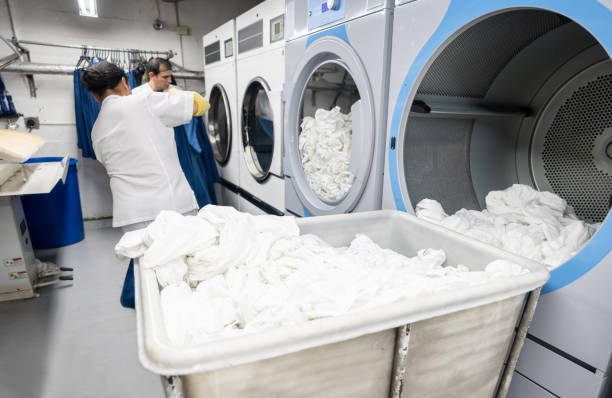
The best fabric choices for industrial laundry depend on three things: how many wash cycles the garment needs to survive, what drying method is used, and whether the washing programme involves bleach. For most rental workwear and occupational uniforms, 65/35 poly-cotton in the 190–260 gsm range is the reliable starting point. The decision gets more specific — and more consequential — when stretch, chlorine bleach resistance, or tunnel drying at 155°C are added to the brief.
This guide covers the main fabric types used in industrial laundry contexts, what makes each one perform or fail, and how to match the construction to the actual washing conditions. For the underlying test standards, see our detailed breakdown of ISO 15797 industrial laundering standards.
Why the fabric choice matters more than people expect
Industrial washing is not an extension of domestic laundering. A tunnel washer in a hospital linen facility or workwear rental operation subjects fabric to a fundamentally different set of stresses: alkaline detergents at 75–95°C, one of three bleaching chemistries (peracetic acid, chlorine, or hydrogen peroxide), mechanical drum action, and then drying — either by industrial tumbler at up to 90°C outlet temperature, or by tunnel/cabinet dryer at around 155°C inlet.
Fabric that handles 40°C domestic washing well can look worn after 15–20 industrial cycles if it was not specified with these conditions in mind. The failure is not random — it follows directly from the mismatch between the fabric’s construction and the actual wash programme.
The question we ask before recommending any fabric is: tumble dry or tunnel dry? Most brands know they need industrial washability. Far fewer have confirmed the drying method their end customer actually uses. It changes the answer significantly — especially for any fabric with a stretch component.
The main fabric types — and how they compare in industrial laundry
65/35 Polyester-cotton — the workhorse
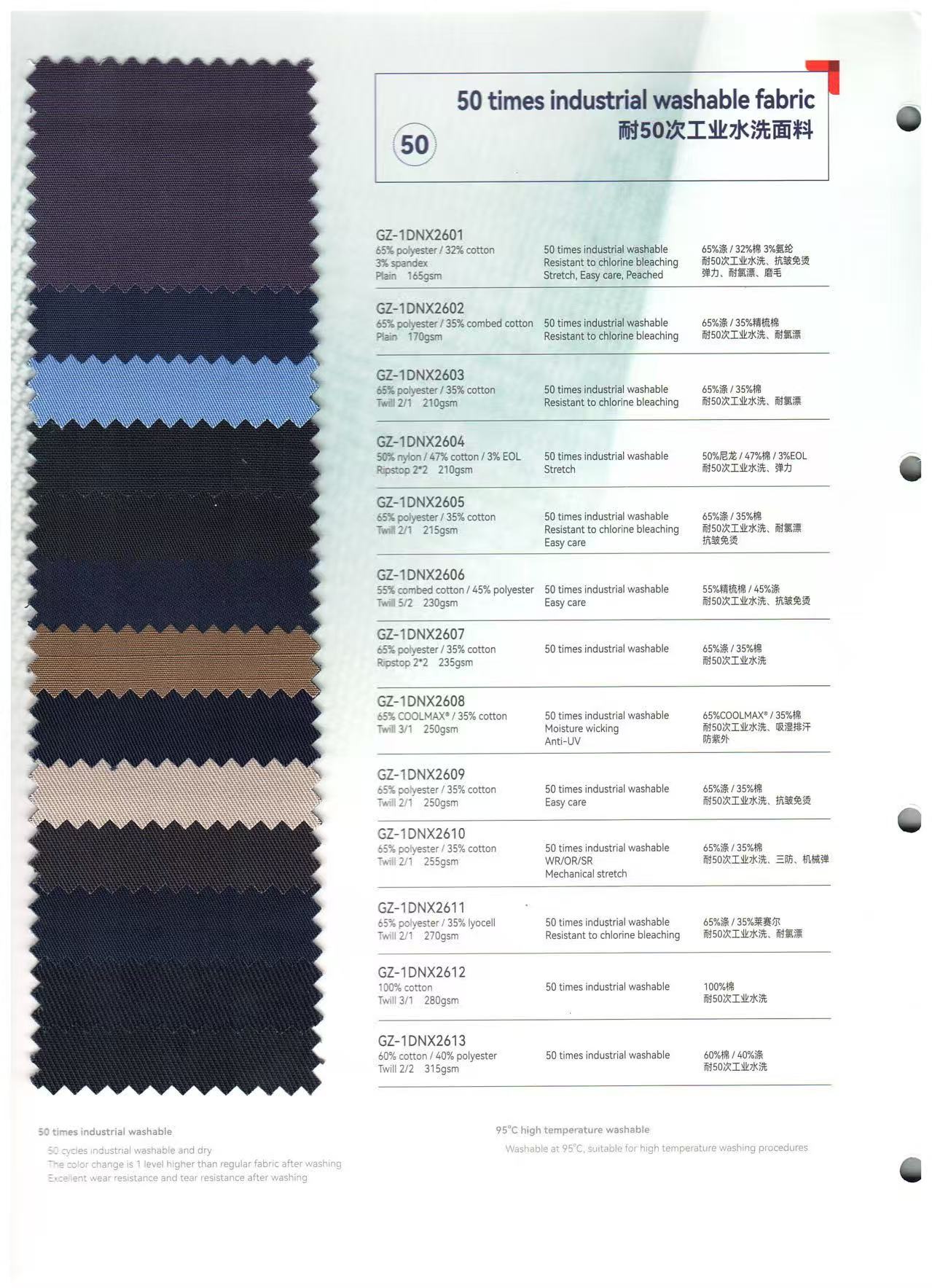
The poly-cotton blend (typically 65% polyester, 35% cotton) is the most widely validated choice for industrial laundry applications. Polyester provides dimensional stability and colour retention; cotton contributes comfort and bleach tolerance. Together they produce a fabric that holds its shape, resists pilling, and maintains colour through repeated high-temperature cycles better than either fibre alone.
Weight range matters here. Lighter constructions (165–190 gsm) are suitable for lower-frequency programmes. For rental workwear running 50–70 cycles, 200–260 gsm is the more practical range — the extra weight provides more resistance to drum abrasion and surface wear.
100% cotton
Pure cotton is the default for white workwear in medical and food-service environments that require chlorine bleaching (ISO 15797 Process 3), because the fibre handles bleach chemistry more reliably than polyester blends at the Process 3 conditions. The trade-off is greater shrinkage risk and lower dimensional stability — cotton garments need tighter pre-shrinking control during fabric finishing.
For coloured workwear, 100% cotton is less common in industrial laundry specifications because colour retention under repeated high-temperature cycling is harder to maintain than with poly-cotton.
| Item | Construction | Weight | Key features |
|---|---|---|---|
| GZ-1DNX2612 | Twill 3/1 | 280 gsm | 50× industrial washable |
Stretch + industrial washable — the most demanding combination
Stretch woven fabrics are increasingly specified for workwear — comfort and freedom of movement are now considered standard in many segments, not a premium feature. The challenge is that the elastomer used to deliver stretch must also survive high-temperature industrial washing and drying.
Standard spandex (elastane) is the most common stretch fibre in the market, but it degrades noticeably under repeated tunnel drying at 155°C. The elastic damage rate for standard spandex fabric after 50 industrial cycles is 50–60%. High-temperature modified polyester elastic fibres — used in our exclusive industrial washable stretch range — keep elastic damage to ≤10% after the same 50-cycle test at 75°C wash and 160°C tunnel drying.
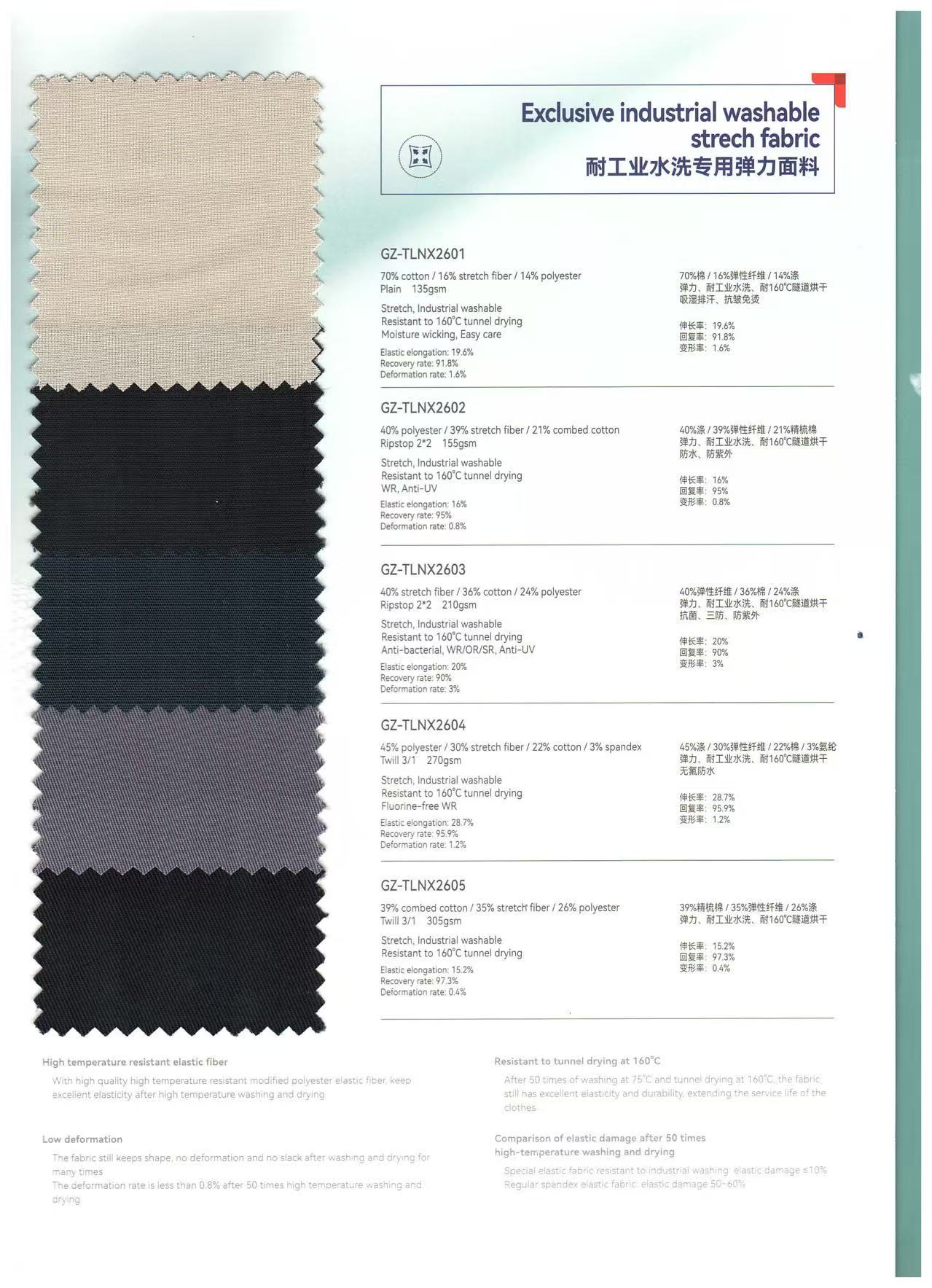
The deformation rate is the number most buyers overlook when comparing stretch fabrics for industrial wash applications. Elongation and recovery are visible on a data sheet. Deformation rate — how much the elastic fibre permanently loses shape after repeated heat cycles — is what determines whether a garment still fits properly at cycle 50. A fabric with 95% recovery but 5% deformation per cycle will look and fit differently by cycle 20. Our GZ-TLNX range keeps deformation at 0.4–3% after 50 cycles at 160°C tunnel drying. That number is what makes the stretch function durable, not just present.
Nylon-cotton blends
Nylon-cotton (typically 50% nylon / 47–50% cotton) offers higher abrasion resistance and a lighter hand than poly-cotton at equivalent weights. It is used in workwear for roles requiring high physical durability — construction, logistics, security. The industrial wash consideration is dye stability: nylon can yellow under certain bleach chemistries, so chlorine-resistance of the dye system needs to be verified for white or pale-coloured garments. For coloured workwear in non-bleach programmes (ISO 15797 Process 7 or 8), nylon-cotton performs well. Our GZ-1DNX2604 (ripstop 2×2, 210 gsm) includes 3% EOL stretch alongside nylon-cotton for flexibility.
Combed cotton / lyocell blends
For workwear where premium hand feel and appearance are priorities alongside washability — hospitality, medical care, airline crew — combed cotton or cotton-lyocell blends offer a smoother surface and softer touch than standard carded cotton. Our GZ-1DNX2606 (55% combed cotton / 45% polyester, twill 5/2, 230 gsm) and GZ-1DNX2611 (65% polyester / 35% lyocell, twill 2/1, 270 gsm) are both 50× industrial washable with chlorine bleach resistance.
How wash cycle count and bleach type should guide your selection
These two variables — how many cycles and what chemistry — do more to determine the right fabric than any other factor, and they are often not defined clearly enough in the initial sourcing brief.
| Wash cycle requirement | Recommended weight range | Typical fabric choice | Notes |
|---|---|---|---|
| Up to 50 cycles | 165–235 gsm | 65/35 poly-cotton, twill or ripstop | Broad range available; colour change ≤1 grade vs. regular fabric |
| 50–70 cycles | 190–245 gsm | 65/35 poly-cotton, higher-density weave | Colour change ≤2 grades vs. regular fabric; meets higher-frequency rental needs |
| 50+ cycles with stretch | 135–305 gsm | High-temp modified stretch fibre construction | Must specify tunnel-dry resistant; deformation rate ≤3% at 160°C |
On bleach chemistry: if the end customer’s laundry uses chlorine bleaching (ISO 15797 Process 3 or 4), the dye selection and fabric finishing must specifically accommodate this. Not all “industrial washable” fabrics are validated for chlorine. Several of our poly-cotton constructions carry explicit chlorine bleach resistance (GZ-1DNX2602, 2603, 2605, 2611) — this is a deliberate specification choice, not a generic claim.
For a full breakdown of how ISO 15797 process numbers map to actual washing conditions, see our ISO 15797 standards guide. For a broader overview of our industrial laundry fabric range and product categories, visit the industrial laundry fabric overview page.
When special finishes make sense
Several function finishes are compatible with industrial washability — but only when they are formulated and tested specifically for that environment. The most common requests we receive alongside industrial washability are:
- WR / OR / SR (water, oil, soil release): Fluorine-free DWR finishes validated to 30 wash cycles under industrial conditions are now standard. Our GZ-TLNX2603 combines WR/OR/SR with antibacterial and Anti-UV in a stretch construction. GZ-1DNX2610 carries WR/OR/SR with mechanical stretch on a 255 gsm poly-cotton.
- Antibacterial / antiviral: Relevant for medical, care, and hotel sectors. GZ-TLNX2603 is antibacterial. Antiviral activity ≥99% after 50 washes is achievable with the right finish formulation (tested to ISO 18184).
- Moisture wicking / Anti-UV: GZ-1DNX2608 (65% COOLMAX® / 35% cotton, 250 gsm) is industrial washable with moisture wicking and Anti-UV — a less common but useful combination for outdoor or physically demanding roles.
- Easy care / anti-crease: Multiple constructions in both the 50× and 70× range carry easy care finishing, relevant for rental operations that need to minimise tunnel-drying time and pressing.
One thing worth flagging on soil release + WR combinations: the two finishes work in opposite directions — SR makes the surface hydrophilic (so stains release in the wash), WR makes it hydrophobic (so liquids bead off). A combined finish can deliver both, but it needs to be specifically engineered for that, and validated post-wash. A standard WR coat applied over an SR finish, or vice versa, will underperform both functions within 15–20 washes.
Want to see the full range with wash test data? Email us for our industrial washable fabric catalogue.
FAQ
Both refer to the number of complete industrial wash-and-dry cycles the fabric is tested to withstand while maintaining acceptable appearance and performance. The difference lies in fabric construction density and yarn quality. 70× fabrics are built with tighter weave structures and higher-grade fibre to maintain colour stability (colour change ≤2 grades vs. regular fabric, compared to ≤1 grade for 50× constructions) and resist surface wear over a longer garment life. For rental workwear accounts expecting high rotation frequency, specifying 70× rather than 50× reduces total replacement cost over the garment lifecycle.
Yes, if the right elastomer is used. Standard spandex has an elastic damage rate of 50–60% after 50 industrial cycles at high temperature. High-temperature modified polyester elastic fibres — as used in our GZ-TLNX range — keep that figure to ≤10% after 50 cycles at 75°C wash and 160°C tunnel drying. The key data points to request are deformation rate and tunnel-dry temperature resistance, not just elongation percentage.
For white workwear subjected to chlorine bleach programmes (ISO 15797 Process 3 for cotton, Process 4 for poly-cotton), the fabric must be dyed with chlorine-resistant dyes and finished accordingly. 100% cotton handles chlorine bleach chemistry most reliably. For poly-cotton, look for explicit “resistant to chlorine bleaching” validation in the fabric specification — not all poly-cotton industrial washable fabrics carry this. In our range, GZ-1DNX2602, 2603, 2605, and 2611 all carry confirmed chlorine bleach resistance.
For 70× industrial washable with a 65/35 poly-cotton, we typically work in the 190–245 gsm range. The lightest option in our 70× range is GZ-2DNX2601 at 190 gsm (twill 2/1), and the heaviest is GZ-2DNX2604 at 245 gsm. The choice within this range depends on the physical demands of the role — 190 gsm is appropriate for lighter-duty or warm-climate applications; 225–245 gsm suits roles with higher abrasion or physical stress.
Lyocell blended with polyester can be validated for industrial washability with the right finishing. Our GZ-1DNX2611 (65% polyester / 35% lyocell, twill 2/1, 270 gsm) is 50× industrial washable with chlorine bleach resistance. The main advantage over standard cotton in this application is a softer, more premium hand feel — relevant for hospitality and care sector workwear where garment appearance and comfort are priorities alongside durability.
Standard ISO 15797 industrial washing runs at 75°C (poly-cotton processes) or 85°C (cotton processes). 95°C washing is a higher-temperature variant used in specific hygiene-critical environments — some medical, pharmaceutical, and food processing operations. Our fabrics rated for 95°C high-temperature washing are specifically validated for this condition, which places additional stress on dyes, finishes, and dimensional stability beyond the standard test parameters.
Looking for a complete overview? Read our guide: Industrial Washable Fabrics for Uniforms and Workwear