
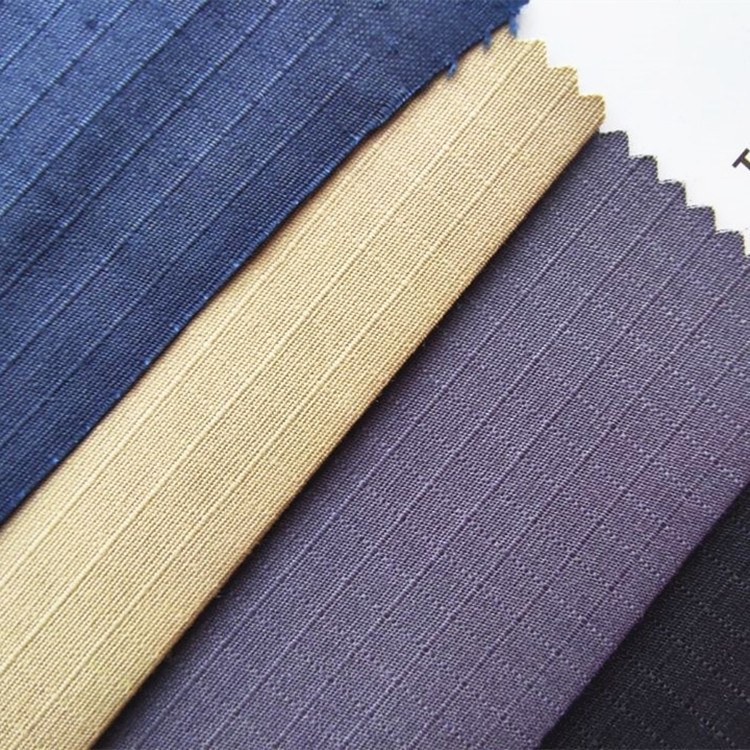
The right cotton ripstop fabric for workwear depends on three variables: fiber composition, fabric weight (GSM), and functional finishing. For most European and North American buyers sourcing professional workwear, 100% cotton ripstop (150–240gsm) covers the majority of use cases — shirts, trousers, and light jackets — while poly-cotton blends step in when you need higher abrasion resistance or dimensional stability after industrial washing. If your end-product requires stretch, a 98/2 cotton-spandex construction is the standard upgrade. Start with end-use first, then work backwards to the spec.
This guide walks through the key decision points buyers face when sourcing cotton ripstop: what makes the weave work, how to match weight to application, where blends beat pure cotton, and what to watch for from a supplier qualification standpoint.
What Makes Cotton Ripstop Structurally Different — and Why It Matters
Standard plain-weave cotton tears along a single thread path once a snag starts. Ripstop changes the failure mode by inserting thicker reinforcement threads at regular intervals — typically every 5–8mm — in a crosshatch grid. When a tear initiates, it hits the next reinforcement thread and stops. The result is not a heavier fabric; it is a fabric with a fundamentally different damage propagation pattern.
This distinction matters for buyers because ripstop’s durability advantage is structural, not weight-based. A 155gsm cotton ripstop can outlast a 200gsm plain-weave cotton in tear resistance. That means you get lighter garments with longer service life — a meaningful argument for field workwear, utility pants, and high-visibility shirts.
👉 For a detailed look at how this translates into finished garments, see our guide: Ripstop Pants: Best Brands and Their Differences.
100% Cotton Ripstop vs. Poly-Cotton Ripstop: Which One Do You Need?
The choice between 100% cotton and poly-cotton ripstop is not about quality — it is about matching the fabric’s performance profile to the job it will do.
| Criteria | 100% Cotton Ripstop | Poly-Cotton Ripstop (65/35 or 50/50) |
|---|---|---|
| Breathability | Excellent — ideal for hot or humid environments | Moderate — reduced by polyester content |
| Abrasion Resistance | Good | Better — polyester adds surface durability |
| Industrial Wash Stability | Requires pre-shrinking; controlled within 3% | Higher dimensional stability out of the box |
| Skin Comfort | Superior natural hand feel | Slightly stiffer; depends on ratio |
| Eco / Certification | GOTS, OEKO-TEX 100 achievable | OEKO-TEX 100 standard |
| Typical Application | Work shirts, summer trousers, tactical garments | Utility trousers, jackets, high-wear uniforms |
👉 For a deeper technical breakdown of poly-cotton constructions in workwear, see: Poly-Cotton Ripstop Fabric for Workwear.
How to Match GSM to End-Use — The Weight Decision Most Buyers Get Wrong
GSM (grams per square metre) is the single most commonly misunderstood variable in ripstop sourcing. Buyers often assume heavier means more durable — but in ripstop construction, durability comes from the weave structure, not the weight. Choosing the wrong GSM inflates garment weight, increases material cost, and may reduce wearer comfort with no durability benefit.
GSM Selection Guide for Cotton Ripstop
- 150–175gsm — Work shirts, hot-environment trousers, hi-vis outerwear. Lightweight and breathable. See: 155gsm Cotton Ripstop Hi-Vis Yellow for Work Shirts →
- 190–220gsm — Standard workwear trousers and jackets. The most versatile range for four-season workwear.
- 240–280gsm — Heavy-duty utility trousers, military-style garments, jackets with high abrasion requirements. See: 280gsm Heavy-Duty Grid Ripstop →
The cause-and-effect here is straightforward: under-weight fabric → premature wear at high-friction zones (knees, seat, cuffs). Over-weight fabric → heat stress complaints from wearers and unnecessary cost. Getting this right upfront avoids expensive rework at the sampling stage.
Functional Finishes: What to Specify Beyond the Base Fabric
The base weave and fiber give you the structural foundation — but finishes determine whether the fabric passes compliance testing and performs in the field. For workwear buyers, these are the most commercially relevant finishing options:
- Waterproof / DWR finishing — Standard for outdoor workwear. If your brand has a sustainability mandate, fluoride-free (C0) DWR is increasingly required by European retailers and brand standards. See our Fluoride-Free Waterproof Fabric →
- IRR (Infrared Reflective) finishing — Required for military and some industrial applications. Reduces the fabric’s IR signature. See: IRR Waterproof Nylon/Cotton Uniform Fabric →
- Pre-shrinking — Essential for 100% cotton. Properly pre-shrunk cotton ripstop should have shrinkage rates within 3%, compliant with ISO wash standards.
- Anti-soil / Teflon coating — For workwear in food service, logistics, or maintenance environments where soil release is a priority.
- Hi-Vis reactive dyeing — For EN ISO 20471-compliant high-visibility workwear. Colour fastness to wash (ISO 105-C06) should be Grade 4 or above.
The most common sourcing mistake here is specifying the finish verbally without tying it to a test standard. Always ask your supplier: which standard does this finish pass, and what’s the minimum performance grade?
Does 100% Cotton Ripstop Shrink? What Buyers Need to Know
Yes — untreated 100% cotton shrinks. The fibers absorb moisture, swell, and contract when dried under heat. Without intervention, you can expect 4–6% shrinkage in the warp direction after the first wash. For garment manufacturers, that means sizing inconsistencies that generate returns and production headaches.
The solution is not to avoid cotton ripstop — it is to specify a properly finished fabric. All Prance cotton ripstop fabrics undergo post-dye pre-shrinking, with warp and weft shrinkage controlled within ±3%, meeting ISO 6330 and EN ISO 15797 benchmarks. When sourcing, ask for wash test reports, not just verbal assurances.
The poly-cotton alternative sidesteps this issue because polyester fibres have minimal moisture absorption — dimensional stability is inherently higher. If industrial laundering compliance is a primary concern for your customer, poly-cotton ripstop may be the lower-risk specification.
🏭 Industry Perspective
In over a decade working with workwear brands in Europe and North America, the most consistent sourcing pain point I see is not the fabric itself — it is misaligned specs at the RFQ stage. Buyers often send enquiries asking for “cotton ripstop fabric for workwear trousers” without specifying GSM, finish, wash standard, or certification. That ambiguity leads to samples that don’t match the end-use, wasted time on both sides, and sometimes a failed season. The brands that move fastest through development are the ones who arrive with a brief: end-use, target GSM range, required certifications, and annual volume. Even a rough brief cuts the sampling cycle by two to three rounds.
— Leila, Fabric Development & Export, Wuhan Prance I&E
Custom Cotton Ripstop: What Can Actually Be Adjusted?
For B2B buyers developing a private-label workwear line, the ability to customise fabric specs is the difference between a commodity product and a defensible brand. For cotton ripstop, the main customisable parameters are:
- GSM and yarn count — controls weight, hand feel, and drape
- Weave grid size — tighter grid (5mm) for finer appearance; wider grid (8–10mm) for more visible structural texture
- Colour — reactive dyeing for 100% cotton; vat dyeing for colour fastness-critical applications
- Width — standard 150cm; wider widths available for specific cut-and-sew efficiencies
- Certifications — OEKO-TEX Standard 100, GRS (for recycled content blends), GOTS for organic cotton
- Minimum order quantity — typically 3,000–5,000 metres per colour per spec
👉 For a full overview of custom development options: Custom Ripstop Fabric for Workwear — What Brands Need to Know.
Frequently Asked Questions
Have a specific workwear project in mind? Share your end-use, target GSM range, and required certifications — and we’ll come back with a shortlist of suitable constructions and sample availability.
📩 Reach us at: sales@ripstopfabric.com
📖 Looking for a complete overview? Read our guide: Ripstop Fabrics for Workwear