
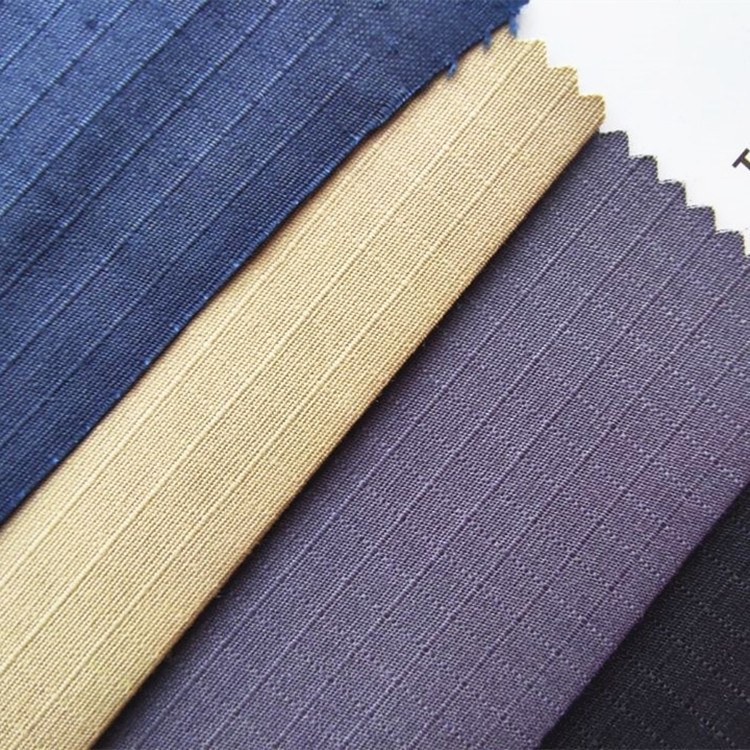
Many buyers searching for ripstop fabric assume it refers to a specific material — usually nylon. That assumption is common, but it can lead to the wrong sourcing decision. In our experience working with workwear brands and garment factories, this single misunderstanding is behind a surprising number of early-stage sourcing mistakes.
Ripstop Is a Weave, Not a Fiber
Ripstop is not a material. It is a weaving technique. Thicker reinforcement yarns are woven into the base fabric at regular intervals, forming a grid pattern that resists tearing once a small cut or puncture starts. This grid can be applied to nylon, but it can just as easily be applied to cotton, polyester, poly-cotton blends, or cotton-nylon blends.
This matters for workwear buyers specifically. A 100% cotton ripstop and a 65/35 polyester-cotton ripstop will behave very differently in an industrial laundry cycle, even though both are technically “ripstop.” Composition, not the grid pattern itself, determines how the fabric handles heat, repeated washing, and shrinkage over the life of a garment. For a closer look at how different ripstop constructions compare for workwear use, it helps to evaluate composition and construction side by side rather than by grid size alone.
The Grid Size Myth
A common purchasing practice is to compare ripstop fabrics primarily by grid size — assuming a larger grid (for example 10x10mm) automatically means a tougher, more tear-resistant fabric, and a smaller grid (2x2mm) is reserved for lighter, lower-durability applications.
This is incomplete. In our experience, grid size is mainly a design choice matched to the customer’s intended look and application, not a fixed indicator of weight class or durability tier. We have produced the same 2x2mm grid in both 150gsm and 220gsm constructions for different customers, depending on what the garment required — the grid size itself did not dictate the weight or the durability outcome. Two fabrics with the same grid size can perform very differently depending on:
- —Yarn count and yarn quality — thicker or higher-quality reinforcement yarns hold up under repeated stress even in a smaller grid
- —Weaving density — how tightly the base yarns are packed between the reinforcement lines
- —Fiber composition — cotton, polyester, and nylon respond differently to abrasion, moisture, and repeated washing
A frequent mistake among buyers is choosing a fabric based on grid size and GSM alone, then discovering during garment production or industrial washing trials that abrasion resistance in stress zones (knees, elbows, pocket edges) does not meet expectations — because the yarn and density behind the grid, not the grid size itself, were never evaluated.
Why Comparing Only GSM and Grid Size Falls Short
GSM (grams per square meter) tells you the weight of the fabric, not its durability. A heavier fabric is not automatically stronger — a well-constructed 220gsm ripstop can outperform a poorly constructed 280gsm fabric in tear and abrasion tests, because construction quality and yarn selection matter more than weight alone.
This is why lab test results on a submitted swatch do not always predict bulk production behavior. In several development projects, we have seen buyers approve a swatch based on GSM and a passing tear-strength report, only to find inconsistencies once the fabric moved from sample loom to bulk production — usually tied to yarn batch variation rather than the fabric specification itself.
What Actually Matters When Evaluating Ripstop Fabric
Instead of comparing fabrics primarily on GSM and grid size, buyers get a more accurate picture by asking suppliers about:
- —End-use scenario — Is the garment for light everyday wear, or does it need to survive industrial laundering and repeated abrasion at stress points?
- —Yarn specification — What yarn count and quality is used for both the base weave and the reinforcement yarns?
- —Weaving density — Is it disclosed, and does it match the intended use case?
- —Batch consistency requirements — Especially for repeat orders, has the supplier defined a shade tolerance and testing method?
- —Testing method and standard — Is tear strength, abrasion resistance, and colorfastness tested in line with relevant ISO standards, or only described qualitatively?
Why Batch Consistency Is a Hidden Risk Buyers Often Miss
One issue that is easy to overlook — but that we deal with directly in production — is shade and batch consistency, especially across repeat orders.
In our experience, buyers often assume that reordering “the same fabric” will produce an identical result. In practice, dye lots and yarn batches can vary between production runs, even when the specification on paper is unchanged. Left-center-right shade variation within a single batch, and lot-to-lot variation across repeat orders, are both real risks if they are not controlled contractually.
Industry Perspective — Technical Advisor, Wuhan Prance
A specific, practical measure we apply: shade tolerance is written into the contract before production, verified using CIE Lab color measurement rather than visual judgment alone. For repeat orders, we run an internal strike-off and match it against the customer’s previous approved batch before bulk production begins — because assuming the original recipe will reproduce the exact same shade is one of the more common, and avoidable, causes of batch complaints in this category. After bulk production, our internal lab runs a full test set — colorfastness, tensile and tear strength, pilling, shrinkage — against the specifications agreed before the order, rather than relying on the buyer to discover problems after the goods arrive.
Buyer’s Checklist Before Ordering Ripstop Fabric
Before finalizing a ripstop fabric order, it helps to confirm:
Conclusion
Ripstop fabric is defined by its weave, not its fiber content — and grid size alone is not a reliable shortcut for evaluating durability. For workwear buyers, the more useful comparison is between yarn quality, weaving density, and how tightly batch consistency is controlled, particularly on repeat orders. Before your next ripstop order, it is worth asking your supplier directly how shade tolerance and testing are handled — the answer will tell you more about long-term reliability than the spec sheet alone.
Browse our full ripstop fabric range by composition and construction, or read how we take a custom development from swatch to shipment for workwear brands.
FAQ
Is ripstop fabric always made of nylon?
No. Ripstop refers to a weaving technique, not a fiber. It can be applied to cotton, polyester, poly-cotton blends, nylon, and cotton-nylon blends.
Does a larger ripstop grid mean a stronger fabric?
Not necessarily. Grid size is largely a design choice matched to the intended application, rather than a fixed indicator of durability. The same grid size can be produced at different weights and constructions — yarn quality, weaving density, and fiber composition play the larger role in actual tear and abrasion performance.
Why did my reorder come out a slightly different shade than the original batch?
This is usually a dye lot or batch variation issue rather than a specification change. It can be controlled by agreeing on a shade tolerance (measured via CIE Lab, not just visual comparison) and requiring a pre-production strike-off match for repeat orders.
What should I ask a supplier before ordering ripstop fabric for workwear?
At minimum: fiber composition and blend ratio, yarn count/density, the testing standard used for tear and abrasion strength, and how shade consistency is controlled across batches.
Looking for a complete overview? Read our guide: Ripstop Fabrics for Workwear