
| Short answer: Since 12 August 2026, the EU’s Packaging and Packaging Waste Regulation (PPWR, Regulation (EU) 2025/40) requires fabric roll packaging — film, paper cores, labels, adhesives, pallet wrap — to meet combined heavy-metal limits (Pb, Cd, Hg, Cr(VI) ≤ 100 mg/kg) and to carry conformity documentation. Recyclability grading, recycled-content targets and stricter material rules follow in stages through 2030 and 2038. At Wuhan Prance, this has changed what we test, document and disclose when preparing fabric shipments for European customers. |
For EU fabric sourcing, compliance no longer stops at the fabric itself. The packaging around every roll is becoming part of the specification.
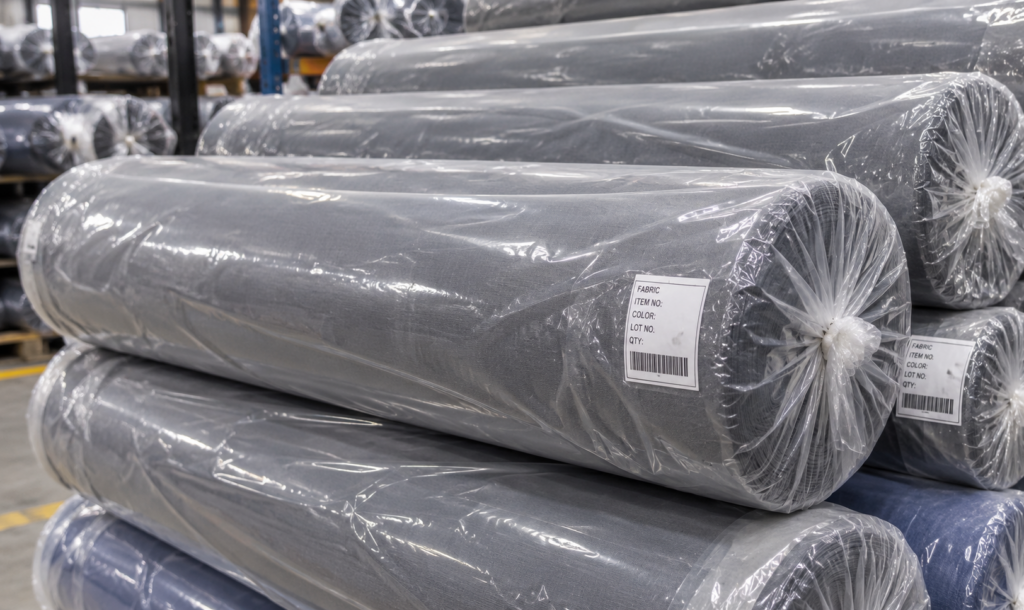
A fabric roll shipped from China may be protected by PE film, supported by a paper core and combined with labels, cartons, pallet wrap or straps. Under the EU Packaging and Packaging Waste Regulation — Regulation (EU) 2025/40, or PPWR — these packaging components require increasing attention.
At Wuhan Prance Import and Export Co., Ltd., this has changed what we examine, test and document when preparing fabric shipments for European customers.
PPWR Timeline for Fabric Exporters
The PPWR has applied generally since 12 August 2026, but its requirements are being introduced in stages.
| Stage | Relevance to Fabric Packaging |
|---|---|
| 12 August 2026 | Relevant substance restrictions, conformity responsibilities and documentation provisions apply. |
| 2030 stage | Design-for-recycling grades, plastic recycled-content targets, packaging minimisation and empty-space rules become especially important. |
| 2035 stage | Packaging must also meet recyclability-at-scale requirements. |
| 1 January 2038 | Only packaging achieving recyclability grade A or B may generally be placed on the market. |
Some deadlines depend on the adoption and entry into force of EU secondary legislation. For example, the design-for-recycling requirement applies from 1 January 2030 or 24 months after the relevant delegated act enters into force, whichever is later.
Heavy Metals: What PPWR Requires and What We Tested
Article 5(4) states that the combined concentration of four heavy metals in packaging or packaging components must not exceed 100 mg/kg:
- Lead, Pb
- Cadmium, Cd
- Mercury, Hg
- Hexavalent chromium, Cr(VI)
This is a combined limit — not a separate 100 mg/kg allowance for each substance.
Wuhan Prance has tested more than ten types of supporting packaging and transport materials. For our transparent PE heavy-duty packaging film, all four controlled heavy metals were reported as not detected.
The method detection limits were 2 mg/kg for lead, cadmium and mercury, and 8 mg/kg for hexavalent chromium.
“Not detected” means that the result was below the applicable method detection limit. It does not mean that the absolute concentration was necessarily zero.
The report provides useful evidence for managing the Article 5(4) requirement. It does not, by itself, demonstrate compliance with every PPWR obligation.
Packaging Design: Why We Prefer Simpler PE and PP Structures
PPWR does not universally require packaging to use a single material. Its focus is whether packaging can be collected, sorted and recycled effectively under the applicable criteria.
However, unnecessarily complex combinations of polymers, coatings, adhesives and other materials can create recycling and sorting difficulties. For relevant plastic packaging, we therefore prioritise simplified mono-material PE or PP structures where practical.
Our typical fabric roll uses a thick transparent PE protective film and a paper core, with a label attached to the film. Although the principal plastic layer is PE, the recyclability of a complete packaging unit may also be affected by its label, adhesive and other components.
Packaging design must also protect the fabric from moisture, dirt, abrasion and handling damage. Material simplification should not come at the expense of necessary transport protection. This is the same balance we apply on the fabric side — for example, in how we source GRS/OCS certified sustainable workwear fabrics without compromising durability.
Our PE Film Recyclability Assessment
Our assessment of the 2 m × 380 m × 0.12 mm PE heavy-duty packaging film under EN 13430:2004 reported a 100% material recyclability result and identified no major non-conformity.
However, this is not the same as receiving a Grade A rating under the future PPWR methodology.
Under Annex II of the PPWR, the future design-for-recycling grades are:
| Grade | Recyclability by Weight |
|---|---|
| A | 95% or more |
| B | 80% or more |
| C | 70% or more |
| Technically non-recyclable | Below 70% |
From the relevant 2030 stage, packaging must generally achieve grade A, B or C. From 2038, grade C packaging will generally no longer be accepted.
The future PPWR assessment will use criteria established under Article 6 and will consider the applicable packaging category and its components. Our existing assessment is useful preparation, but it should not be presented as a final PPWR grade or proof that the complete packaging system satisfies every requirement.
What We Are Preparing for Next
Article 7 introduces minimum post-consumer recycled, or PCR, content for plastic packaging. Ordinary non-contact-sensitive plastic packaging may fall within the category subject to a 35% target from 1 January 2030 or three years after the relevant implementing act enters into force, whichever is later. The target for this category increases to 65% in 2040.
The percentage is calculated as an average per manufacturing plant and year for each packaging type and format. It is not necessarily a requirement that every individual film roll contain exactly 35% PCR.
Our current documentation does not establish a PCR percentage for the PE film. Confirming the material source and obtaining recycled-content documentation from packaging suppliers is therefore an important next step in our preparation.
We are also monitoring future requirements concerning packaging weight, volume and empty space. For fabric shipments, these requirements must be balanced with the need to protect rolls throughout international transport.
Supporting European Customers with Packaging Information
Our present approach includes:
- Selecting simplified PE or PP structures where practical
- Testing supporting packaging materials for controlled heavy metals
- Assessing the material recyclability of our PE heavy-duty film
- Maintaining material information, test reports, SVHC documentation and relevant internal records
- Monitoring secondary legislation that will define future PPWR assessment methods
Not every record in this internal file is expressly required by the PPWR. Together, however, these documents can help answer buyer questionnaires, support supplier audits and make packaging discussions more efficient — the same documentation-first approach we take with our GRS/OCS sustainable fabric program.
Frequently Asked Questions: What Should Fabric Buyers Ask Their Suppliers?
What material is used for each packaging component?
Ask your supplier to break packaging down by component — protective film, core, label, adhesive, pallet wrap — rather than describing it as one material. Our typical fabric roll uses a transparent PE heavy-duty film with a paper core and a label attached to the film.
Does the packaging contain composite layers, labels or adhesives that may affect recycling?
A single dominant plastic (PE or PP) does not guarantee full recyclability on its own — the label, adhesive and any coatings on it also count. We prioritise simplified mono-material structures where practical, while still meeting transport-protection needs.
Has the packaging been tested for Pb, Cd, Hg and Cr(VI)?
Yes — our transparent PE heavy-duty film returned “not detected” results for all four controlled heavy metals, against method detection limits of 2 mg/kg (Pb, Cd, Hg) and 8 mg/kg (Cr(VI)). Ask any supplier for the underlying test report and its detection limits, not just a pass/fail statement.
Has recyclability been assessed, and under which methodology?
Our PE heavy-duty film was assessed under EN 13430:2004 with a 100% material recyclability result and no major non-conformity. This is useful preparation, but it is not the same as a Grade A/B/C rating under the PPWR’s future Annex II methodology, which will apply from the 2030 stage.
Can the supplier provide test reports, material information and supporting records?
For our European orders, Wuhan Prance can provide available packaging-material information, heavy-metal test results and recyclability-assessment documentation on request. If you have specific PPWR-related packaging requirements, tell us before production so they can be reviewed alongside the fabric specification.
Packaging specifications may now deserve the same attention as fabric composition, construction, weight, colourfastness, strength and finishing.
This article provides general information and does not constitute legal advice. Applicability should be assessed according to the actual packaging, transaction and supply-chain roles.
Primary sources:
Regulation (EU) 2025/40
and the
European Commission’s Guidance Document (Commission Notice C/2026/3084, OJ C, 10.6.2026).