
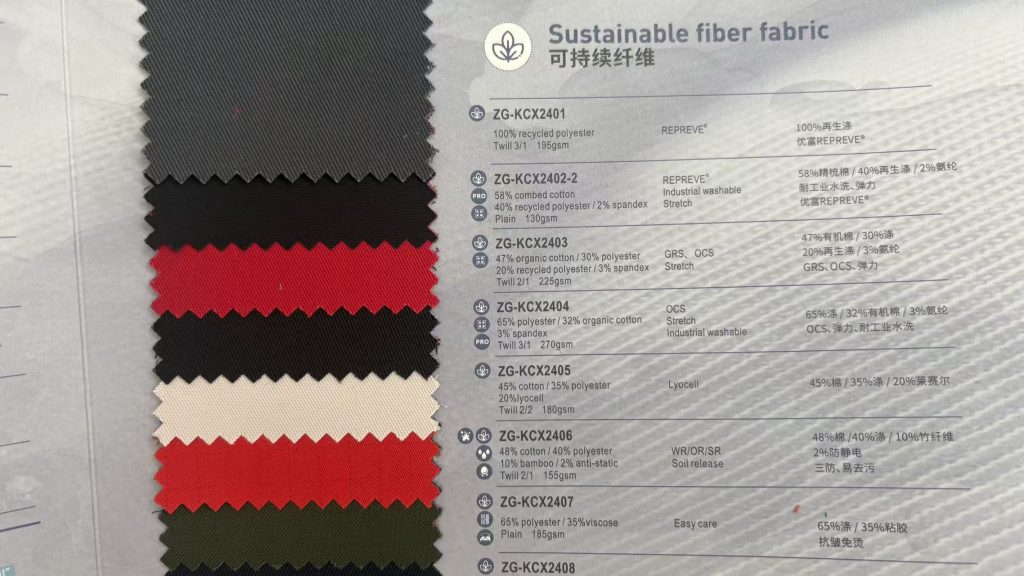
When you order GRS-certified recycled polyester or OCS-certified organic cotton workwear fabric, three things determine whether your claim will hold up: a valid Transaction Certificate matched to your exact order, fiber content and fabric specifications confirmed in writing before production, and certification on both the supplier’s side and your own. Skip any one of these and you have a fabric that might be recycled — not a claim you can defend to a customer or an auditor.
We’ve supplied GRS recycled polyester and OCS organic cotton fabric to workwear brands for several years now, and the questions buyers ask almost always come down to one thing: how do I know this order is actually what the paperwork says it is? This guide walks through exactly what to check, in the order we’d check it if we were sourcing on your side of the table.
GRS vs. OCS: What Each Certification Actually Verifies
These two certifications get used almost interchangeably in casual conversation, but they verify different things and apply to different fibers. Confusing them is one of the most common mistakes we see from buyers new to sustainable sourcing.
| GRS (Global Recycled Standard) | OCS (Organic Content Standard) | |
|---|---|---|
| Applies to | Recycled fibers, primarily recycled polyester (rPET) in our supply chain | Organic cotton and other organically grown fibers |
| What it verifies | Recycled content percentage plus social and environmental criteria at every processing stage | Organic fiber content from farm through to final product |
| Minimum content | 20% recycled material to certify; 50%+ required to carry the GRS logo | Content percentage is stated directly on the certificate, no fixed logo threshold |
| Certificate issued | Transaction Certificate (TC) per shipment | Transaction Certificate (TC) per shipment |
Both standards are managed by Textile Exchange, and both work the same way procedurally: a third-party certification body audits the supply chain, and every shipment gets its own Transaction Certificate. That’s the document that actually matters to you as a buyer — not the certificate on the mill’s wall, but the paperwork tied to your specific order.
See: GRS Certified Recycled Polyester Fabrics
Industry Perspective
The mistake we see most often is a buyer treating the mill’s GRS scope certificate as proof enough. It isn’t. The scope certificate tells you the facility is capable of handling certified material. It says nothing about the fabric in your specific shipment. Always ask for the Transaction Certificate that names your order.
Why the Transaction Certificate Is the Document That Matters
Certification only works if it’s required on both sides of the transaction. If your company isn’t GRS or OCS certified as a buyer, your supplier legally cannot issue you a Transaction Certificate for that order — and without a TC, there is no verifiable link between the certified raw material and the fabric sitting in your warehouse.
A valid TC states the fiber composition and recycled/organic content percentage, the certified quantity and delivery details, and the certification body that issued it. Request the TC before or at shipment, not after — if a supplier can only produce it weeks later, that’s worth asking about.
Brands that make this a standing requirement, rather than an occasional spot-check, are in a much stronger position if a customer, retailer, or auditor ever asks them to substantiate a sustainability claim.
Fabric Specifications to Confirm Before You Order
Certification tells you the material is legitimate. It doesn’t tell you the fabric will perform the way your existing product does. Most GRS recycled polyester and OCS organic cotton fabrics are made to order, which means these specs need to be agreed in writing before production starts:
- Fiber composition and blend ratio — e.g. recycled polyester/cotton blends, and whether the recycled content applies to the whole blend or one fiber only
- Fabric weight (GSM) — recycled fiber can behave slightly differently in the loom than virgin fiber; confirm the finished weight, not just the greige target
- Yarn count and density — affects hand feel and durability, and is where a lot of “looks similar on paper” fabric quietly diverges from your original spec
- Colorfastness rating — particularly relevant for darker or saturated colors, where dye uptake on recycled fiber can differ from virgin fiber
- Recycled/organic content percentage — get this as an exact number in the contract, not a range
If you’re switching an existing workwear fabric to a certified version, the easiest path is to hand your current spec sheet to the supplier and ask them to match it in GRS or OCS material — that keeps the transition close to a drop-in replacement rather than a redesign.
GRS Recycled Polyester vs. OCS Organic Cotton: Where Each One Makes Sense
Buyers sometimes ask us to simply pick one. In practice they solve different problems, and most workwear programs end up using both somewhere in the range.
| GRS Recycled Polyester | OCS Organic Cotton | |
|---|---|---|
| Best suited for | Durability-focused workwear, abrasion resistance, blends needing stretch or strength | Comfort-focused garments, breathable layers, brands prioritizing natural fiber positioning |
| Known limitation | Harder to reach very high whiteness on bleached fabric; higher MOQ than virgin polyester | Lower abrasion resistance than synthetic blends; typically higher cost per meter |
| Cost vs. virgin equivalent | Moderately higher, driven by certification and traceable sourcing | Noticeably higher, driven by organic farming yield and certification costs |
Neither trade-off is a reason to avoid either material — they’re the reason to be specific about which problem you’re solving before you brief your supplier.
A note on recycled nylon: it follows the same GRS logic described above, but the raw material sourcing (often reclaimed fishing nets and industrial nylon waste) and typical use cases are different enough that it deserves its own guide rather than a few lines here.
FAQ
Does a supplier’s GRS certificate automatically cover my order?
No. The supplier’s certificate confirms the facility can process certified material. Your specific shipment needs its own Transaction Certificate to be verifiable.
Can I get a Transaction Certificate if my own company isn’t certified?
No — certification is required on both the buyer and supplier side before a TC can be issued for that transaction.
Is GRS recycled polyester more expensive than virgin polyester?
Generally yes, due to certification costs and typically higher minimum order quantities, though the gap has narrowed as recycled supply chains have matured.
Can I convert an existing fabric spec to a certified version without changing the look or feel?
In most cases, yes — sharing your current specification with the supplier is usually enough for them to match it in certified material.
Looking for a complete overview? Read our guide: https://ripstopfabric.com/sustainable-workwear-fabrics/
If you’re sourcing GRS recycled polyester or OCS organic cotton fabric for an upcoming collection, get in touch with our team — we can talk through specs and certification requirements before you commit to an order.