
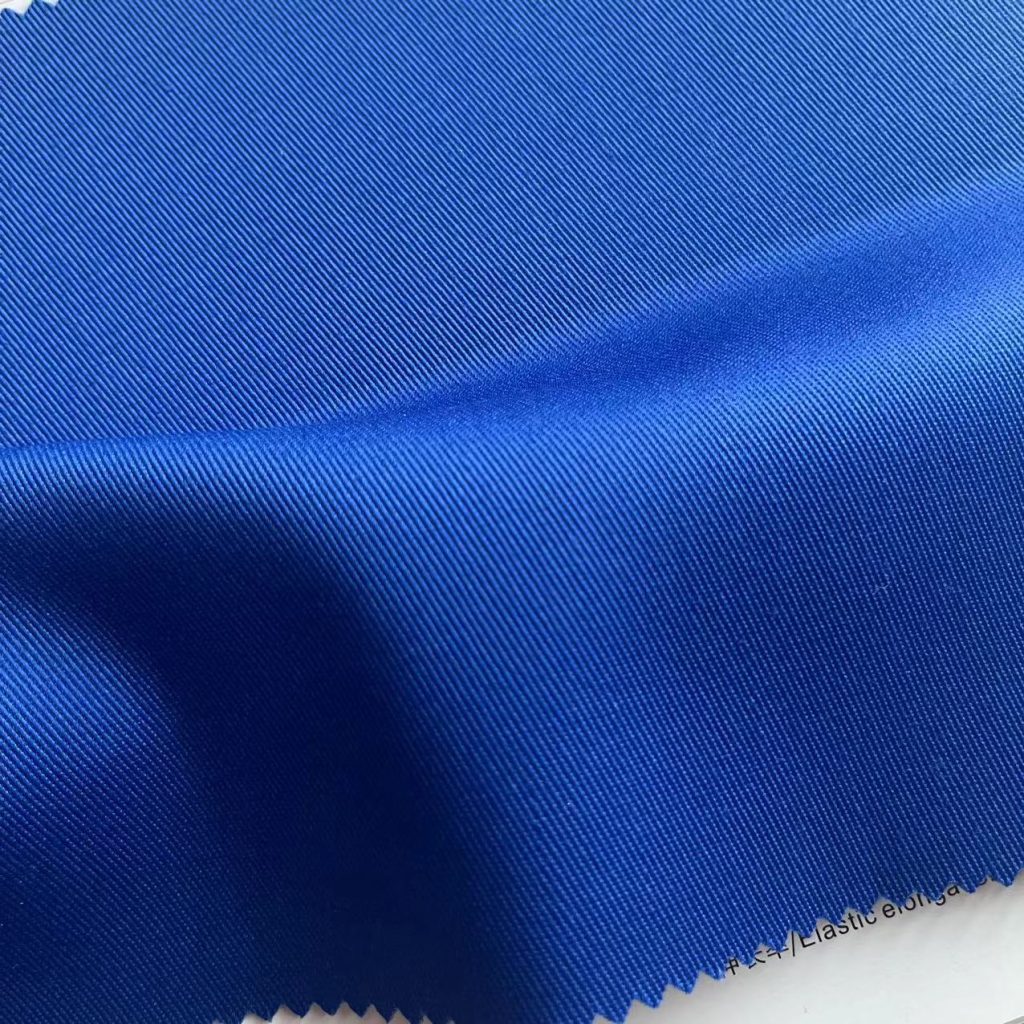
Buyers often come across the term “elastomultiester” on a tech sheet or supplier quotation and aren’t sure what it actually is — or how it differs from other stretch options they’ve heard of, like mechanical stretch or spandex. In our experience, one specific confusion comes up repeatedly: buyers assume mechanical stretch (a spandex-free weave that stretches through yarn structure alone) and elastomultiester (an actual stretch fiber) are the same thing. They are not, and the difference affects how the fabric performs over time. If you’re evaluating EME for an actual order — not just researching the term — jump to the sample & pricing section below.
What Is Elastomultiester and How Does It Work?
Elastomultiester (EME) is a multi-component co-polyester fiber. A well-known branded example is LYCRA® T400®, developed by INVISTA. Unlike spandex, elastomultiester achieves elasticity through its physical molecular structure: the dual-component polyester forms a spring-like shape that provides natural stretch and recovery — the elasticity is built into the fiber itself, not added through a separate elastic yarn.
Key characteristics include:
- —Built-in stretch with no spandex
- —Enhanced breathability and moisture management
- —Excellent thermal stability, supporting high-temperature washing and drying
- —Chlorine resistance, suited to repeated industrial laundering
How Does Elastomultiester Compare With Spandex and Mechanical Stretch?
| Feature | Elastomultiester (EME) | Spandex (Elastane) | Mechanical Stretch |
| Stretch mechanism | Elastic fiber built into yarn | Elastic fiber built into yarn | Yarn twist / weave structure only — no elastic fiber |
| Stretch (%) | 10–20% (stable) | Up to 500% | Typically lower, structure-dependent |
| Elastic recovery | Good (low fatigue) | Excellent | Depends on weave holding up; can loosen with repeated wash |
| Industrial wash safe | Yes | Often degrades | Yes, but recovery may reduce over time |
| Cost efficiency | Moderate | Higher | Lower (no elastic fiber cost) |
| Dyeing compatibility | Easy to dye | Requires separate dyeing | Easy to dye (same as base yarn) |
This table also explains why elastomultiester is not a drop-in replacement for spandex when maximum stretch percentage is the priority — its strength is stability and wash durability at a moderate stretch range, not maximum elongation. It also clarifies where mechanical stretch differs: there is no elastic fiber involved at all, so its recovery depends entirely on the weave structure rather than fiber-based elasticity.
Need real test data instead of general specs? We can share wash-cycle recovery comparisons across EME, mechanical stretch, and spandex constructions we’ve tested.[Request comparison data →]
Why Elastomultiester Is Not the Same as Mechanical Stretch
This is where we see the most confusion in buyer inquiries. Mechanical stretch refers to stretch created purely through yarn twist and weave structure — no elastic fiber is involved at all. The fabric stretches because of how the yarns are woven and set, and recovery depends entirely on that structure holding up over repeated wear and washing.
Elastomultiester, by contrast, is an actual stretch fiber blended into the yarn. The elasticity comes from the fiber’s molecular structure, not from the weave. This has a practical consequence: mechanical stretch fabrics can lose recovery faster under repeated industrial washing, because there is no elastic fiber contributing to recovery — only the weave structure. Elastomultiester-based fabrics tend to hold recovery more consistently over repeated high-temperature washing, because the fiber itself resists fatigue, not just the construction.
A frequent mistake among buyers is treating these two options as interchangeable on a spec sheet — assuming “stretch workwear fabric” means the same performance regardless of which mechanism is behind it. In practice, the right choice depends on the required stretch percentage, the wash cycle count and temperature, and how much recovery loss is acceptable over the life of the garment. If mechanical stretch is what you’re evaluating specifically, it’s worth reading more on how mechanical stretch fabric works and where it fits before comparing it against fiber-based options like EME.
Case Study: Our 43/23/34 Polyester/Cotton/EME Ripstop Fabric
One of our EME-based workwear fabrics has the following composition:
- —Composition: 43% polyester / 23% cotton / 34% EME
- —Weave: Ripstop
- —Elongation: 15.7%
- —Key features: heat washable, tear-resistant, dry-touch, stable stretch recovery
This is one of several EME fabric options we offer — browse the full stretch fabrics range for other constructions, or send us your specification for full customization.
Typical Procurement Process
- Customer provides specs (tech sheet or physical swatch)
- We review and provide a quotation
- If price is acceptable, we send similar samples for evaluation
- For more cautious clients, we offer lab dips or made-to-sample development (sampling requires a sample fee)
- Sample lead time is typically 30–40 days, similar to bulk production lead time
- Upon sample approval, bulk order is confirmed
- During bulk production, we run internal tests and send random bulk samples to the client
- Once the bulk sample is approved, we arrange final shipment
Where Elastomultiester Fits in the Current Workwear Market
As more workwear programmes move away from spandex due to industrial wash limitations and recycling concerns, elastomultiester-based (T400-type) fabrics are increasingly used as a spandex-free stretch option in polyester-cotton workwear, particularly for programmes requiring frequent high-temperature laundering. Adoption varies by brand and programme, so it’s worth confirming with any supplier what specific wash-cycle and recovery data they can share for the construction you’re evaluating, rather than relying on general claims about which brands use which fiber.
Is Elastomultiester Fiber Environmentally Friendly?
Elastomultiester is a synthetic polyester, but it does not contain spandex, which makes recycling more straightforward — many recycling processes find non-spandex fabrics easier to process. For brands seeking technical fabrics with a lower long-term environmental impact, EME-based materials offer a practical compromise between performance and recyclability.
Buyer’s Checklist: Elastomultiester vs Mechanical Stretch vs Spandex
Before specifying a stretch mechanism, it helps to confirm:
Conclusion
Elastomultiester is a stretch fiber, not a weave technique — and it is not interchangeable with mechanical stretch, which relies on yarn structure alone rather than an elastic fiber. For workwear buyers comparing stretch options, the more useful question is not “which one is best” but “which mechanism matches your required stretch percentage and wash durability.” Before specifying either option, ask your supplier what mechanism is actually behind the word “stretch” on the spec sheet.
FAQ
Is elastomultiester the same as spandex?
No. Elastomultiester (EME) is a co-polyester fiber that achieves stretch through its molecular structure, without spandex. It offers lower stretch percentage than spandex (typically 10–20% vs. up to 500%) but better industrial wash durability.
Is mechanical stretch the same as elastomultiester?
No. Mechanical stretch comes from yarn twist and weave structure alone, with no elastic fiber involved. Elastomultiester is an actual stretch fiber blended into the yarn. They perform differently, especially in recovery after repeated industrial washing.
Is EME fabric good for workwear?
It depends on the requirement. For programmes needing high-temperature industrial laundering and stable recovery over many wash cycles, EME is generally a strong option. If very high stretch percentage is required, spandex may still be necessary.
Why does my supplier’s quote just say “stretch workwear fabric” without specifying the mechanism?
This is common, but it’s worth asking directly whether the stretch comes from an elastic fiber (like EME or spandex) or from the weave structure alone (mechanical stretch) — the distinction affects both stretch percentage and long-term recovery performance.
Still deciding whether EME fits your programme?
Send us your target stretch %, wash-cycle requirement, and construction (e.g. blend ratio) — we’ll tell you honestly whether EME, Sorona, or spandex is the better fit, and share comparative recovery data where we have it.
📖 Looking for a complete overview? Read our guide: Stretch Workwear Fabrics