
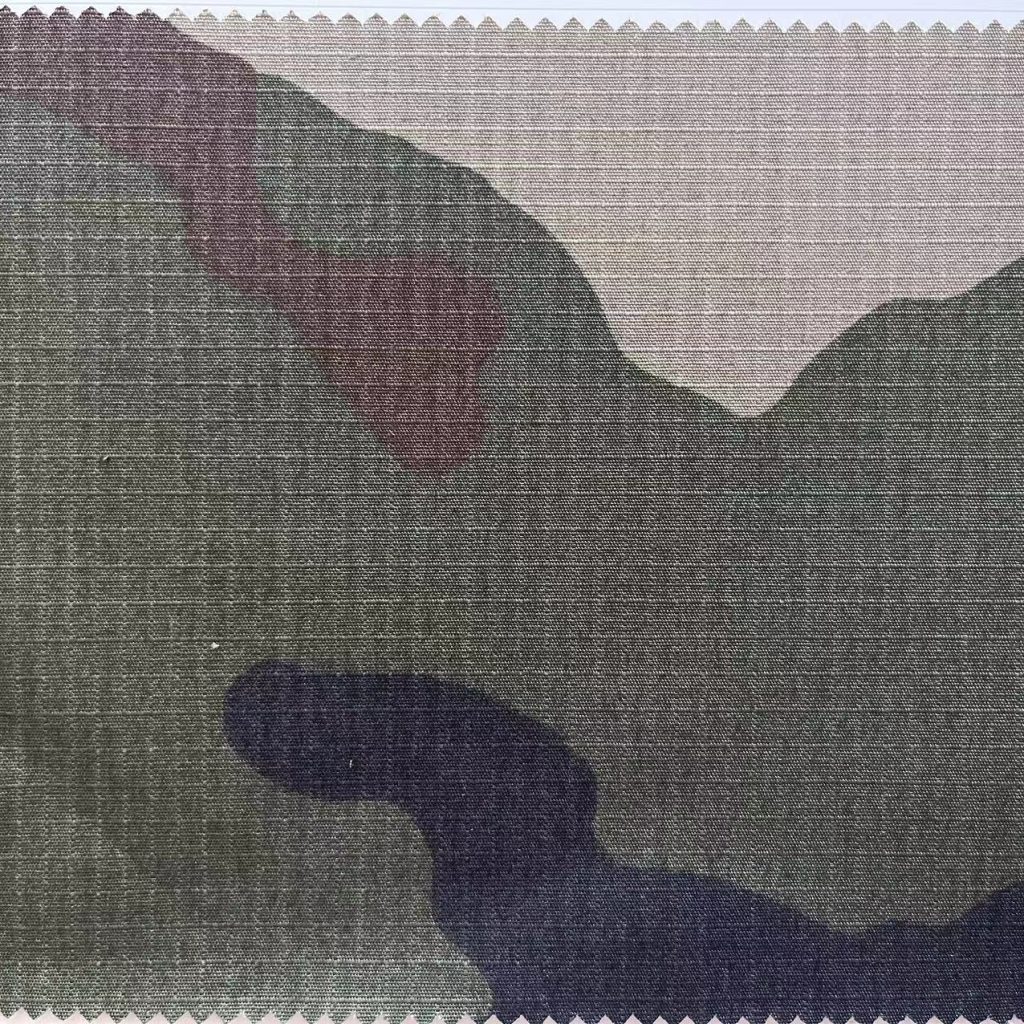
Case Study: Developing a Near-Infrared Camouflage Fabric for Tactical Use
Background
A tactical equipment company from Eastern Europe approached us about a camouflage fabric project that had already given them a lot of trouble. Before they contacted us, they had tested samples from more than ten other suppliers, and none of them passed. Their original fabric had been sourced locally, but that supplier could no longer produce it, so they had to look elsewhere.
This was not a normal camouflage order. The pattern and color had to look right, but more importantly, the fabric had to pass strict spectral testing across UV, visible light, and near-infrared ranges. Passing the official military laboratory test was the real target.
What the Customer Sent Us
They gave us:
- A camouflage pattern
- An original fabric sample for reference
- Their spectral testing requirements
The target was a polyester/cotton blend, 240–280gsm, twill construction.
First Problem: Even Their Reference Sample Didn’t Pass
Before doing anything else, our lab tested the sample the customer sent us. It turned out that even this original fabric could not meet their own testing requirements. So copying it exactly was never going to work — we had to actually solve the underlying problem, not just match what they already had.
Getting the Infrared Performance Right
Our technical team started adjusting the color formulation, focusing especially on the grey-yellow shade in the pattern. We found that making this color slightly deeper had a real effect on infrared reflection, without changing how the camouflage looked to the eye. The customer reviewed our test data and approved this direction.
We produced strike-off samples within three days and sent them out.
When the Numbers Didn’t Match Up
The customer submitted our samples to the official military testing laboratory. Two days later, the result came back: the sample passed infrared, but failed UV.
This didn’t match what we were seeing in our own lab, so our team looked into it carefully. It turned out the difference likely came down to testing method, not the fabric itself. A few things stood out:
- The customer’s spectrophotometer (a SF26 model with PDO-1 attachment) measured the grey-yellow color starting from 250nm, while the original spec called for measurement starting from 400nm — a much stricter range.
- Their reflectance curve showed sudden jumps in the 250–450nm range for the white fabric, and a similar sharp drop for grey-yellow between 650–850nm. In our experience, dye reflectance changes gradually, not in sudden spikes like that — which usually points to a calibration issue or interference during testing, not an actual property of the fabric.
We shared this analysis with the customer and suggested they check their equipment calibration, test each wavelength range separately instead of combining them, and possibly run a third-party test for comparison.
The customer’s response told us how much was riding on this: it needed to go through their ministry’s approval process, and they didn’t want to push back on the lab’s result without being sure. They asked, quite reasonably, whether we were fully confident in our own numbers before they raised the issue internally.
A Second Reference Sample, and a Lesson About Whiteness
About a week later, the customer sent us a different fabric — one that had already passed UV testing elsewhere — asking if we could match it. They specifically wanted to see options beyond 100% cotton, including nylon/polyamide and polyester versions, since their sample was cotton.
After testing this new reference, we found the key factor was the whiteness value, not the fiber content — the sample had an unusually high whiteness reading. We tried other fiber options, but only 100% cotton could realistically achieve the whiteness level needed. We spent that week sourcing a bleached base fabric of the right weight and working on the printing.
We ended up producing ten strike-off samples for this round.
Result
According to the customer’s feedback, at least five of the samples passed testing.
We stayed in touch with the customer for the following several months. In the end, the order didn’t move forward — not because of the fabric, but because a new regulation in the customer’s country restricted the purchase of textiles not manufactured domestically. The customer told us clearly that if local production becomes possible, or if they get permission to import, the order is still there and it’s a large one.
Interestingly, not long after, another company contacted us with the exact same fabric requirement. We developed and tested samples for them too, and they passed. That order didn’t close either, this time over payment terms — but it told us this specific fabric problem is a real, recurring need in the market, not a one-off request.
What This Project Showed Us
Camouflage fabric that also needs to pass rigorous spectral testing is a genuinely different challenge from standard camouflage printing. It takes fabric construction knowledge, color chemistry, lab testing capability, and — just as important — the patience to work through testing discrepancies with a customer step by step until both sides understand exactly what’s being measured and why.
At PRANCE, this kind of technical back-and-forth is part of how we develop functional fabrics for demanding applications, whether the end use is workwear, tactical gear, or other protective equipment.
If You Have a Near-Infrared Fabric Requirement
Infrared reflectance requirements are not the same everywhere — a fabric developed for one terrain or one testing standard will not necessarily pass in another region. Because of this, we’re not able to quote or start sampling from a pattern alone.
To give you an accurate quote and start development, we’ll need:
- Fabric construction details (composition, weight/gsm, weave, yarn density)
- The camouflage pattern
- Your spectral testing requirements (wavelength range, equipment/standard used, target values)
Send us these details and we’ll let you know what’s possible for your project.