
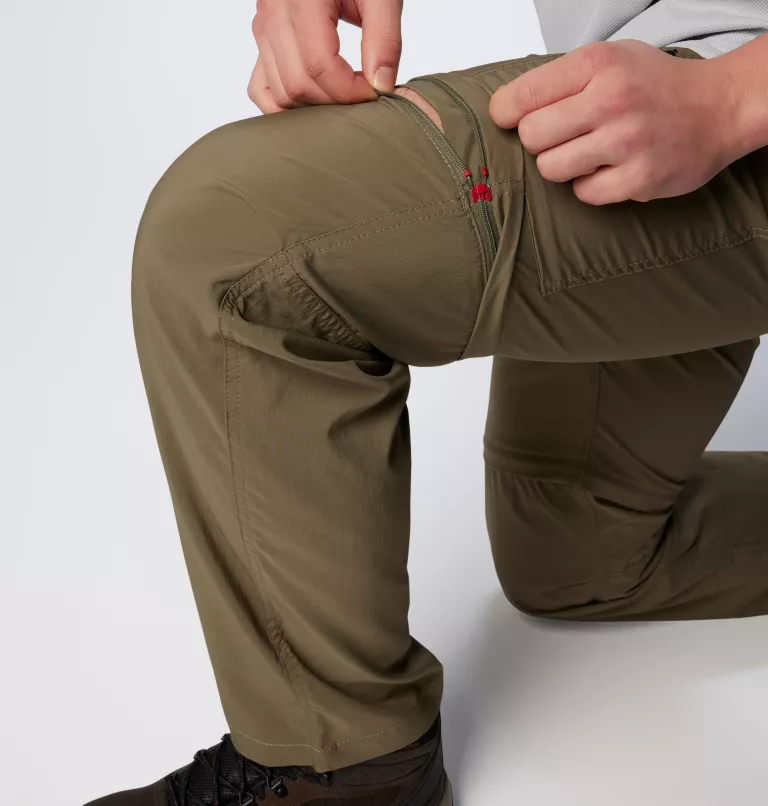
T400 (LYCRA® T400®, developed by INVISTA) is a bicomponent polyester stretch fiber that provides permanent, spandex-free elasticity. Workwear brands use it because it keeps its shape through heavy industrial washing, tolerates tunnel drying at 160°C, and delivers consistent elastic recovery over the life of a garment — performance that conventional elastane cannot reliably match in demanding uniform programs.
How does T400 create stretch without spandex?
T400 is made by fusing two different polyester components into a single filament. Because the two components have different shrinkage rates, the combined fiber develops a natural crimp during heat finishing — essentially a permanent coil or spring embedded in the fiber structure. That coil is what gives T400 fabrics their elasticity.
This matters for a specific reason: the mechanism that creates stretch in T400 is entirely polyester-based. It does not rely on a rubber-like elastane core that can degrade. So when the fabric goes through a 75–85°C industrial wash cycle, or a 160°C tunnel dryer, the stretch mechanism remains intact. The garment recovers its shape rather than gradually losing elasticity and bagging out at stress points — knees, seat, elbows — after a few months of service rotation.
Some T400 variants, including T400 EcoMade, incorporate recycled PET and plant-based materials, which makes them relevant for brands working toward lower-impact sourcing without compromising performance.
T400 vs traditional spandex in workwear: what actually changes?
The stretch fiber choice affects not just how a garment feels on day one, but how it performs after six months of a commercial laundry schedule. Here is a direct comparison across the properties that matter most for uniforms.
| Property | T400 (bicomponent polyester) | Spandex / Elastane |
|---|---|---|
| Stretch mechanism | Physical crimp in bicomponent polyester — permanent by structure | Rubber-like elastane polymer — degrades over time |
| Industrial wash (75–85°C) | ✓ Stable — no meaningful performance loss | ✗ Degrades — loss of recovery, yellowing, fabric distortion |
| Tunnel drying (160°C) | ✓ Compatible — used in industrial laundry programs | ✗ High heat accelerates breakdown |
| Chlorine bleach resistance | ✓ Good — relevant for healthcare and food-service uniforms | ✗ Poor — oxidative bleach weakens elastane rapidly |
| Shape retention (50+ wash cycles) | ✓ Deformation rates as low as 0–0.4% in tested fabrics | ✗ Gradual bagging common beyond 20–30 industrial cycles |
| Dyeing process | ✓ Dyes with polyester in one bath | ✗ Often requires separate dyeing step |
| Moisture management | ✓ Wicks moisture; quick-drying | Neutral — depends on blend |
| End-of-life recyclability | ✓ All-polyester — easier to recycle | ✗ Mixed polymer — harder to separate and recycle |
The trade-off is straightforward: spandex offers higher raw elongation (up to 500%), which is why it dominates fashion and activewear. But for workwear — where garments are washed on an industrial schedule and worn on rotation for one to three years — sustained performance under repeated stress matters more than peak stretch. T400’s elongation of roughly 15–25% is sufficient for unrestricted movement, and it holds up over the full service life of the garment.
For a broader look at how different stretch fibers and construction methods compare across workwear applications, our stretch workwear fabrics guide covers the full category.
Our T400 workwear fabrics: tested specifications
The fabrics below are from our current range of T400-based workwear materials. Each has been tested through industrial laundry cycles, including tunnel drying at 160°C, and verified for dimensional stability. Deformation rates of 0–0.4% after 50 washes reflect how the fabrics perform in practice, not just in lab conditions.
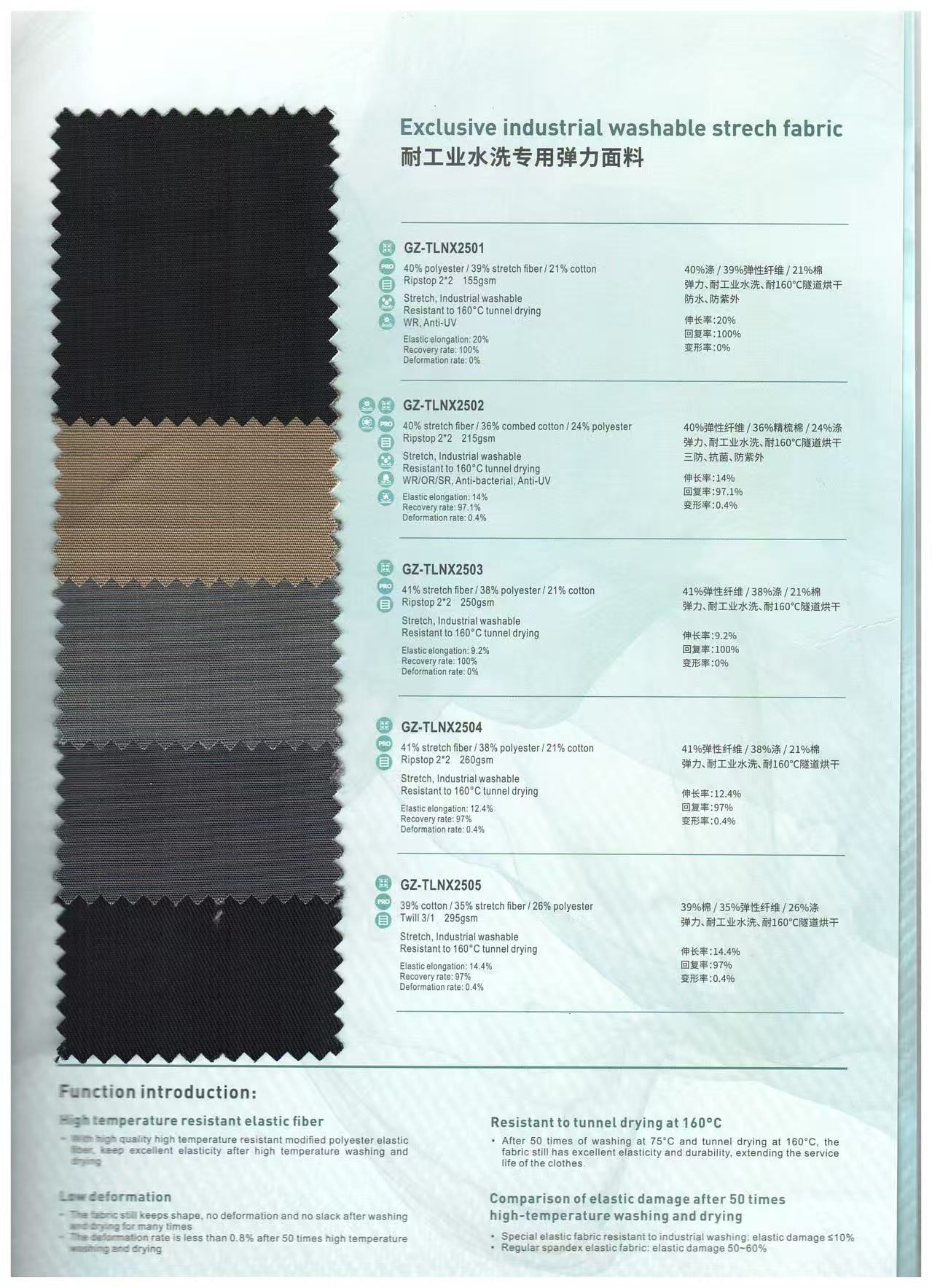
GZ-TLNX2501
Composition: 40% polyester / 39% T400 / 21% cotton
Weight: 165 gsm
Deformation after 50 washes: 0%
Best for: Lightweight uniforms — shirts, summer workwear, warm-climate applications
Lightweight
GZ-TLNX2503
Composition: 41% T400 / 38% polyester / 21% cotton
Weight: 250 gsm
Elastic recovery: High
Best for: Jackets, trousers, mid-weight uniforms requiring strong shape retention
Mid-weight
GZ-TLNX2505
Composition: T400 / polyester / cotton blend
Weave: Twill 3/1
Weight: 255 gsm
Best for: Heavy-duty workwear — construction, logistics, maintenance applications
Heavy-duty
These are representative options from a broader range. We also support custom compositions, weights, and weave structures based on your technical brief. If you are comparing options or need to match an existing spec, we can send samples and test data to support your evaluation.
Our perspective: what to watch for when sourcing T400 fabrics
T400 is a registered brand owned by INVISTA — it refers specifically to their bicomponent polyester fiber, not a generic fiber category. When suppliers describe a fabric as “T400-based” or using “T400 fiber,” it is worth confirming whether the actual INVISTA-produced fiber is used, or whether the claim is being applied loosely to a bicomponent polyester from a different source. Both can perform well, but they will not be identical, and performance data from one should not be assumed to apply to the other.
We also see buyers focus heavily on elongation percentage when evaluating stretch fabrics. For workwear, dimensional stability after laundering — measured as deformation rate — is the more meaningful number. A fabric with 30% stretch that shows 3–5% deformation after 50 washes will not maintain its cut and fit. A fabric with 18% stretch and 0–0.4% deformation will. Ask for the wash test data, not just the hand-feel spec.
If sustainability is a factor in your sourcing decisions, T400 EcoMade (using recycled PET and bio-based content) is worth considering alongside standard T400. Our article on sustainable and stretch fabric options for workwear brands covers how to balance performance and environmental requirements when upgrading a range.
Where T400 workwear fabric is used
T400’s combination of durable stretch, industrial wash resistance, and moisture management makes it a practical fit across several workwear segments:
- Industrial uniforms — factories and manufacturing environments where garments face daily wear and frequent commercial laundering
- Construction and site workwear — pants and jackets needing stretch at the knees and back without bagging over a season
- Healthcare uniforms — where chlorine bleach resistance is required and all-day comfort matters
- Logistics and transportation — driving and loading positions that put sustained stress on seating areas
- Maintenance and facilities — garments worn hard daily and rotated through an on-site laundry
- Denim-style workwear — T400 blends well with cotton and polyester to produce stretch denim constructions for casual uniform programs
For brands sourcing at volume, our stretch workwear fabric B2B sourcing page covers MOQ, lead times, customization options, and the typical sampling process for bulk orders.
Frequently asked questions
The key difference is structural. Elastane is a rubber-like polymer that weakens progressively under repeated high-temperature washing, alkaline detergents, and oxidative bleaching. T400’s stretch mechanism is based on a physical crimp in a bicomponent polyester filament, which is not meaningfully affected by the same conditions. In practical terms, T400 fabrics show deformation rates of 0–0.4% after 50 industrial wash cycles, while spandex-based fabrics typically begin showing visible shape loss well before that point.
Spandex delivers higher raw elongation (up to 500% vs T400’s roughly 15–25%) and better initial recovery, which is why it is used in activewear and fashion stretch fabrics. For workwear, however, durability under repeated industrial laundering is the priority. T400 maintains its stretch performance and garment shape through heavy wash programs where spandex would degrade. It also simplifies dyeing (one bath), improves chlorine bleach resistance, and makes end-of-life recycling more practical due to its all-polyester composition.
T400 is a specific commercial product (LYCRA® T400® by INVISTA) that falls within the broader EME (Elastomultiester) fiber category. EME is the generic classification for bicomponent co-polyester stretch fibers with over 15% elongation. T400 is the most widely recognized EME product, but other manufacturers produce bicomponent polyester stretch fibers under different trade names. When comparing fabrics, confirm which fiber is being used and ask for performance data specific to that fiber.
Our current T400 range covers 165–255 gsm. Lighter weights (165–200 gsm) suit shirts, summer uniforms, and warm-climate applications. Mid-weights (220–255 gsm) work well for trousers, jackets, and year-round uniform programs. The right weight depends on the end use, laundering method, and any functional finish requirements (DWR, FR, etc.). We can discuss specific requirements if you share a technical brief or reference fabric.
Yes. T400-based workwear fabrics can be tested against EN ISO 15797 (industrial laundering procedures for workwear testing) and ISO 30023 (dimensional change in industrial laundering). If your program requires certified test reports, specify this when requesting samples and we can provide documentation to support your approval process.
T400 EcoMade is a variant that incorporates recycled PET and plant-based content. It is available in selected fabric constructions. For brands building toward GRS certification or lower-impact sourcing, it provides a way to use T400’s performance profile while improving the material footprint of the product. Contact us to confirm availability and minimum order requirements for EcoMade-based fabrics.
Looking for T400 workwear fabric for your next uniform program?
📖 Looking for a complete overview? Read our guide: Stretch Workwear Fabrics