
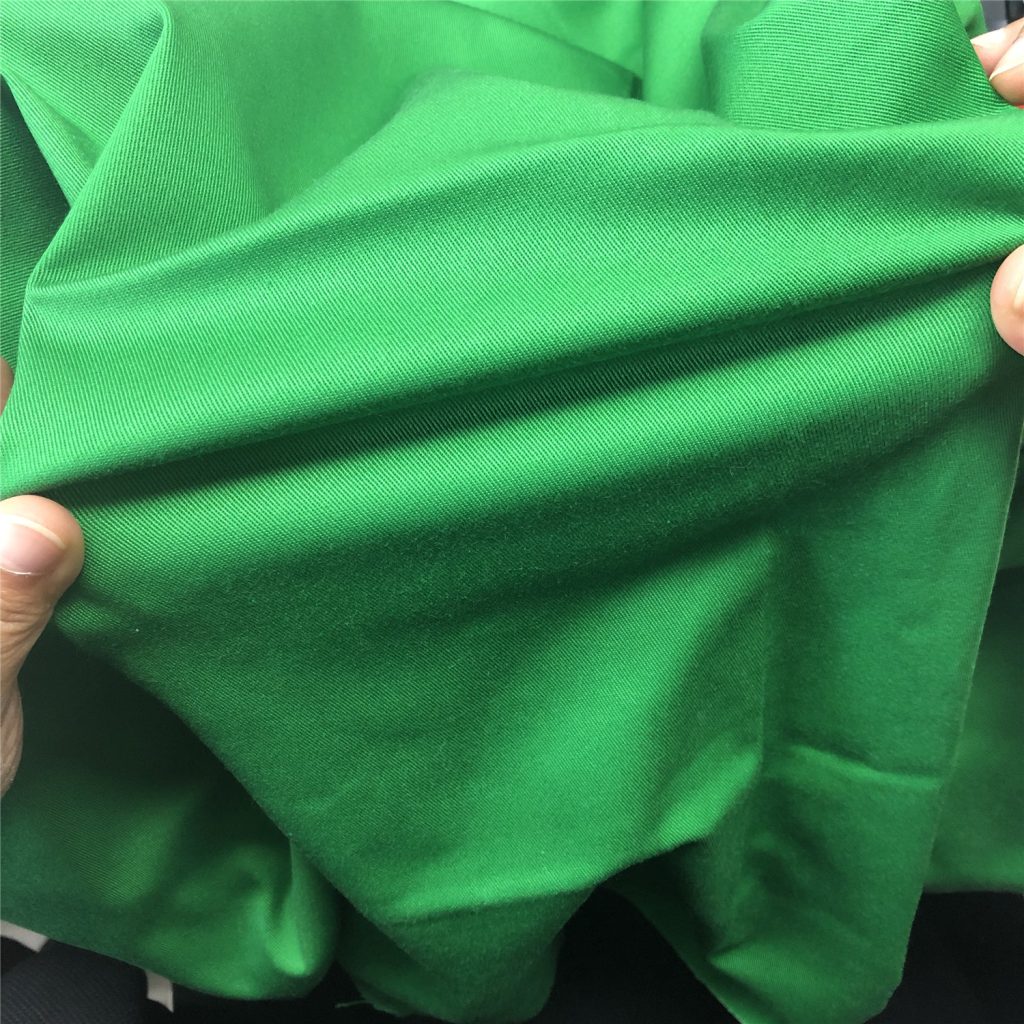
Mechanical stretch fabric achieves its stretch through yarn structure and weave construction — not through spandex, elastane, or any other elastic fiber. The stretch is moderate (typically 10–18%) but stable: it does not degrade with repeated washing, chlorine bleach, or industrial laundry heat. For workwear and uniform applications, this makes it a practical alternative to elastic-fiber stretch where long service life and wash durability matter more than maximum stretch range.
If you’re sourcing fabric for workwear, uniforms, or professional garments, you’ve likely encountered “mechanical stretch” as a specification — often listed alongside or as an alternative to spandex blends, T400, or EME fiber constructions. This article explains what it means, how it works, and what to look for when specifying it.
What Is Mechanical Stretch Fabric?
Mechanical stretch fabric is a woven fabric that has built-in stretch — without any elastic fiber content. There is no spandex, no elastane, no T400, no EME, and no Sorona in the construction. The stretch comes entirely from how the fabric is made: specifically, from the twist level of the yarns and the geometry of the weave structure.
This distinguishes it from the majority of stretch wovens on the market, which achieve their stretch by incorporating a small percentage (typically 2–5%) of elastic fiber into the yarn blend. In mechanical stretch fabrics, that elastic fiber component is absent by design.
How Does Mechanical Stretch Work?
The stretch in mechanical stretch fabrics comes from two interlocking factors:
1. High-twist yarn construction
Yarns are twisted at a higher rate than standard weaving yarns during spinning. A highly twisted yarn has a coiled, spring-like geometry. Under tension, the coil can extend; when tension is released, it returns toward its original form. This gives the yarn — and by extension, the fabric — inherent stretch and recovery without any elastic fiber.
2. Weave structure
The interlacing pattern of the weave determines how much the yarns can shift relative to each other under load. Twill weaves — where each yarn crosses over multiple warp or weft threads before going under — allow more yarn movement than tight plain weaves, which is why twill constructions typically yield more effective mechanical stretch. The weave geometry also determines whether the stretch is primarily in the warp direction, weft direction, or both.
Mechanical stretch is not produced by a finishing process applied after weaving. The stretch is built into the fabric at the yarn and weave level. Post-weave finishing (including heat-setting) can help stabilize dimensions, but it does not create the stretch — the construction does.
What Fiber Compositions Support Mechanical Stretch?
The mechanical stretch approach is compatible with several fiber compositions used in workwear. The stretch comes from construction, not composition, so the fiber type determines the fabric’s other performance properties rather than its stretch mechanism.
The compositions we produce in mechanical stretch:
- 100% cotton — Good breathability and moisture comfort. Compatible with chlorine bleach wash programs. Preferred for applications where pure natural fiber content is required or specified.
- Poly-cotton blend (T/C) — Typically 65/35 or 80/20 polyester/cotton. Higher abrasion resistance and faster dry time than pure cotton. Better dimensional stability across wash cycles. The most common base for workwear mechanical stretch.
Neither composition contains elastic fiber. This is relevant for buyers who need to declare fiber content, manage care labeling, or source for programs where spandex-free construction is a requirement.
How Much Stretch Does It Have?
Mechanical stretch fabrics typically achieve 10–18% extension in the stretch direction, depending on yarn twist level, weave construction, and fabric weight. For context:
- Spandex-blended wovens typically achieve 25–40%+ stretch
- T400 or EME blended wovens typically achieve 15–30%
- Mechanical stretch wovens typically achieve 10–18%
For most workwear mobility requirements — bending, reaching, crouching — 10–18% extension is sufficient. The stretch range becomes a limiting factor in applications that require high-stretch recovery, close fit, or articulated construction (e.g. pre-shaped knee panels in tactical pants).
Performance Through Industrial Washing
The primary advantage of mechanical stretch in workwear applications is wash durability — specifically, the absence of a degradation pathway.
Elastic fiber stretch fabrics degrade through three main mechanisms in industrial laundry: chlorine bleach (which breaks down spandex rapidly), high-temperature wash cycles (which fatigue elastic fiber at repeated exposure), and mechanical action in tunnel washing and tumble drying. Over time, stretch performance decreases and fabric shape can distort.
Mechanical stretch has none of these vulnerabilities. The stretch is structural — it lives in the yarn twist and weave geometry, neither of which is affected by bleach chemistry, temperature, or mechanical action. Stretch performance remains consistent across 50+ industrial wash cycles in our testing.
This makes mechanical stretch appropriate for:
- Garments on industrial laundry rental programs (where bleach-based wash protocols are standard)
- Uniforms with EN ISO 15797 or ISO 30023 wash durability requirements
- Multi-year uniform programs where consistent garment performance across the service life is a procurement requirement
Which Weave Structures Work Best?
Not all fabric constructions produce equally effective mechanical stretch. Based on production experience, the hierarchy is:
- Twill weaves — Best stretch response. The float structure of a twill (2/1, 3/1, or herringbone) gives yarns more freedom to shift under load. Most workwear mechanical stretch fabrics use a twill base.
- Plain weave — Moderate stretch. Tighter interlacing limits yarn movement, so stretch range is lower than twill. Still functional for applications that don’t require the full 15–18% range.
- Small check or dobby patterns — Limited stretch. The complex interlacing in fine check patterns restricts yarn movement significantly. Not recommended if stretch performance is a primary specification.
Fabric weight also affects stretch range: heavier fabrics (above ~280 gsm) produce less extension than lighter constructions at equivalent twist levels, because the additional yarn mass resists deformation.
When to Specify Mechanical Stretch — and When Not To
Mechanical stretch is the right specification when:
- The garment will go through industrial laundry programs, particularly those using chlorine bleach or high-temperature tunnel wash
- Long service life and consistent performance across the garment’s lifecycle are priorities
- Spandex-free construction is required for fiber content, care labeling, or sustainability reasons
- The application needs moderate freedom of movement rather than high-stretch recovery (work trousers, jackets, coveralls, shirts)
- Cost efficiency matters — mechanical stretch fabrics sit below T400 and EME blends on price
Elastic fiber stretch is likely a better specification when:
- The garment requires stretch above 20–25%, close fit, or high-stretch recovery
- The application is performance or tactical workwear with articulated construction
- The wash program does not involve chlorine bleach and temperature is controlled below 60°C
Fabric sourcing
Request samples of our mechanical stretch fabrics
Available in 100% cotton and poly-cotton blends. Suitable for industrial laundry programs.
FAQ
Does mechanical stretch fabric contain spandex?
No. Mechanical stretch fabrics contain no elastic fiber of any kind — no spandex, elastane, T400, EME, or Sorona. The stretch comes entirely from yarn twist and weave construction.
How much stretch does a mechanical stretch fabric have?
Typically 10–18% in the stretch direction, depending on construction. This is less than spandex blends (25–40%+) but sufficient for most workwear mobility requirements. If your application needs more than 20% stretch, a T400 or EME blend is likely more appropriate.
Can mechanical stretch fabric be washed with chlorine bleach?
Yes, for cotton and poly-cotton constructions. Both fiber types are bleach-compatible, and since there is no elastic fiber content, chlorine bleach does not affect stretch performance. This is one of the main advantages over spandex-containing fabrics in industrial laundry programs.
Will the stretch degrade after repeated industrial washing?
No. The stretch mechanism is structural — yarn twist and weave geometry — neither of which degrades through washing, heat, or chemical exposure. Stretch performance is stable across the garment’s service life, which is the key advantage over elastic fiber constructions in high-wash-frequency applications.
Which weave structure gives the most stretch?
Twill weaves consistently produce more effective stretch than plain weaves or dobby/check patterns. The float structure of a twill gives yarns more freedom to shift under load. If stretch performance is a primary requirement, specify a twill base construction.
What is the difference between mechanical stretch and T400 or EME stretch?
T400 and EME are elastic fiber technologies — the stretch comes from a modified polyester fiber blended into the yarn, similar in principle to spandex. Mechanical stretch has no elastic fiber; the stretch is entirely structural. Both T400 and EME offer higher stretch range than mechanical stretch, but mechanical stretch has better bleach resistance and a lower cost position. The right choice depends on the stretch range required and the wash program the garment will go through.
Related articles
- What are the Main Benefits of Mechanical Stretch Fabrics over Traditional Elastic Fabrics?
- Why Mechanical Stretch Fabric is the Ideal Choice for High-Performance Workwear
- What is EME Stretch Fiber and Why Is It Ideal for Workwear Fabrics?
- T400 Stretch Fabric for Workwear: Spandex-Free, Industrial Wash Ready
📖 Looking for a complete overview? Read our guide: Stretch Workwear Fabrics