
Many workwear buyers treat recycled polyester as a straightforward upgrade — slightly higher cost, same performance, better sustainability story. In practice, the decision is more nuanced than that. Performance differences are smaller than most people expect. But the certification process is more demanding than most people realise. This article covers both honestly.
Written for workwear brands and garment manufacturers evaluating recycled polyester (rPET) fabric for professional and industrial applications.
Performance: Closer Than You Might Think
Tear Strength and Abrasion Resistance
In our experience supplying both rPET and virgin polyester fabrics to workwear brands and garment manufacturers, the physical performance difference between the two is minimal in standard constructions. Tear strength and abrasion resistance are primarily determined by yarn count, fabric construction, weaving density, and finishing — not by whether the polyester fibre originated from recycled or virgin material. Buyers who request side-by-side sample testing under the same construction and weight typically find it difficult to distinguish the two on performance alone.
Industrial Washing
This holds true after repeated industrial washing as well. Dimensional stability, colour retention, and appearance after 50 wash cycles are comparable between rPET and virgin polyester when the fabric construction is equivalent. The variables that matter most — yarn twist, weave tightness, dyeing process, and finishing treatment — are the same for both. Neither fibre type is inherently more wash-durable than the other.
The One Area Where It Does Matter: White and Near-White Colours
If your programme requires bright white or very light colours, this is worth flagging before sampling. Recycled polyester fibre can carry slight inherent colour variation between batches — a result of the mixed origins of post-consumer raw material. Virgin polyester provides a cleaner, more consistent white base. For dark and mid-tone colours, this is rarely a visible issue. But for healthcare uniforms, food service whites, or any programme where bright white is a specification requirement, we recommend confirming colour consistency expectations with your supplier before committing to rPET.
Cost: What the Price Difference Actually Reflects
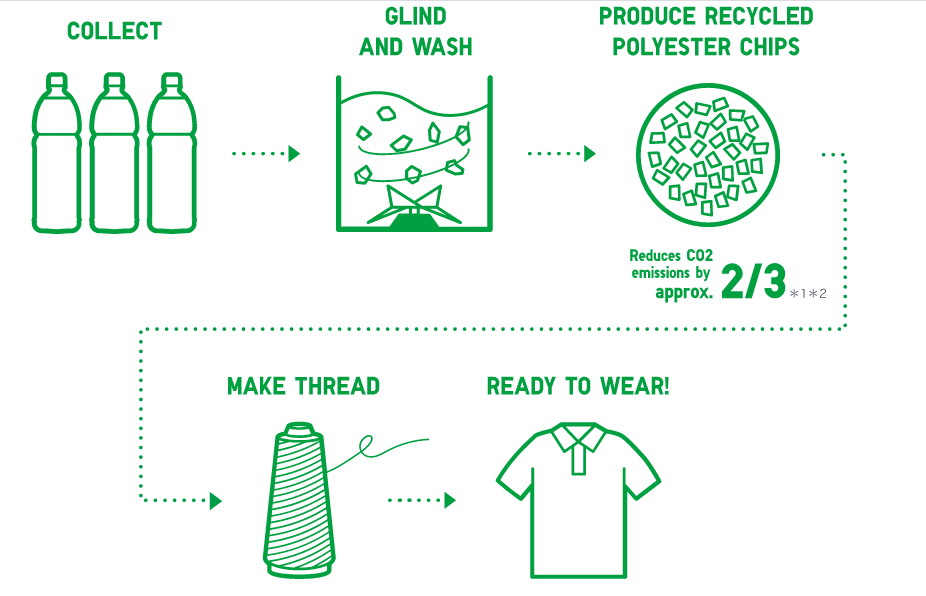
The cost premium for rPET fabric over comparable virgin polyester varies significantly depending on recycled content percentage and fabric weight. In our sourcing experience, the difference typically ranges from around USD 0.02 to USD 0.15 per metre — with higher recycled content and heavier constructions sitting toward the higher end of that range. This is not a fixed markup. It reflects the actual cost of certified recycled yarn, which involves additional collection, sorting, processing, and certification steps compared to standard polyester production.
For most buyers, the cost difference is manageable and is offset by the ability to meet customer sustainability requirements or brand commitments. The more significant commercial consideration is not unit price — it is MOQ and lead time, which we cover below.
MOQ and Lead Time: The Part Most Buyers Underestimate
This is where the practical difference between rPET and virgin polyester becomes most significant for buyers planning production.
For standard virgin polyester fabric constructions, our typical MOQ is 3,000–5,000 metres per colour. For GRS-certified rPET fabric, the MOQ is generally around 10,000 metres. This is not an arbitrary commercial decision — it reflects the structure of the certified rPET yarn supply chain. Certified yarn is available from a smaller number of spinners, and the traceability requirements of GRS mean that batches need to be tracked from fibre through to finished fabric. Smaller runs are harder to manage within that system.
Lead time for GRS-certified rPET fabric is typically around 40 days from order confirmation — somewhat longer than equivalent virgin polyester constructions. This additional time is primarily driven by raw material pre-booking and the coordination required to generate complete GRS documentation before shipment.
Buyers planning seasonal programmes should factor both the higher MOQ and longer lead time into their development calendar. We have seen projects run into delays when buyers assume rPET sourcing works on the same timeline as standard polyester.
GRS Certification: What It Actually Requires
This is the area where we see the most misunderstanding among buyers — including buyers who have been sourcing fabric for years.
The most common assumption is that GRS certification is primarily a matter of cost — that by paying a small premium, buyers receive certified recycled fabric and can make recycled content claims to their customers. In practice, the certification chain is more specific than that.
GRS requires a transaction certificate (TC) to be issued for each order. The TC documents the chain of custody from recycled fibre through yarn, through fabric, to the buyer. For a TC to be issued, the buyer must also hold a valid GRS scope certificate — meaning their own company is registered and certified within the GRS system. If a buyer does not hold their own GRS scope certificate, we as the fabric supplier cannot issue a TC to them, regardless of whether the fabric itself is made from certified recycled yarn.
The practical implication: if you intend to make GRS-verified recycled content claims on your garments, you need your own scope certificate in place before ordering. The application process takes time, so this should be initiated early in development — not after bulk fabric has been ordered.
There is also a documentation requirement at the order level. For a TC to be issued correctly, the commercial invoice, packing list, and contract must all reference the GRS certification, specify the recycled content percentage, and match the payment records. Discrepancies between documents — even minor ones — can delay TC issuance and hold up shipment.
For buyers who do not require GRS documentation — for example, those using rPET for internal sustainability targets without making public claims — the process is simpler. We can supply fabric made from recycled yarn without the full TC chain. But buyers should be clear about their requirements before development begins, as changing the documentation approach mid-order is disruptive for both sides.
Our rPET Fabric Constructions
We supply GRS-certified recycled polyester fabrics in a range of constructions for workwear and uniform programmes. Available blends include:
- Recycled polyester / cotton blends
- Recycled polyester / organic cotton blends
- Recycled polyester / organic cotton / spandex blends
- Recycled polyester / viscose blends
- Recycled polyester / Tencel™ blends
Transaction certificates are provided with every GRS order where the buyer holds a valid scope certificate. For buyers in the process of obtaining GRS certification, we are happy to advise on documentation requirements based on our experience working through this process with other clients.
Practical Checklist Before Ordering rPET Fabric
- Confirm whether your programme requires GRS transaction certificates or only internal recycled content tracking
- If GRS TCs are required, verify your own scope certificate is current before placing an order
- Clarify colour requirements early — for bright white or very light colours, request rPET colour consistency samples before committing
- Factor in 10,000m MOQ for GRS-certified constructions when planning order quantities
- Allow approximately 40 days lead time for GRS-certified fabric, plus additional time for TC documentation
- Ensure commercial invoice, packing list, and contract all reference GRS certification with correct recycled content percentages
- Request wash test data for the specific construction — do not assume wash performance based on fibre type alone
Frequently Asked Questions
Q: Does rPET fabric perform as well as virgin polyester in industrial washing programmes?
Based on our experience, yes — for standard workwear constructions, performance after repeated industrial washing is comparable. The key variables are fabric construction and finishing, not fibre origin. We recommend requesting wash-tested samples for the specific construction you are evaluating.
Q: Can we use rPET fabric without GRS certification?
Yes. If you do not need to make GRS-verified recycled content claims to your customers, we can supply fabric made from recycled yarn without full GRS transaction certificate documentation. MOQ and lead time requirements may be more flexible in this case. Clarify your requirements at the start of development.
Q: Why is MOQ higher for GRS-certified rPET than for standard fabric?
GRS-certified yarn is sourced from a smaller number of certified spinners, and the traceability requirements of the standard require batch-level documentation through the supply chain. This makes smaller production runs more difficult to manage within the certification system. Our typical MOQ for GRS-certified rPET fabric is around 10,000 metres, compared to 3,000–5,000 metres for standard constructions.
Q: What documents are needed to receive a GRS transaction certificate?
The buyer must hold a valid GRS scope certificate. The commercial invoice, packing list, and contract must reference the GRS certification and specify the correct recycled content percentage. Payment records must match the contract. Any discrepancy between documents can delay TC issuance.
📖 For a broader overview of sustainable fabric options for workwear, see our guide: Sustainable Workwear Fabrics
Get in Touch
Evaluating recycled polyester fabric for your workwear programme? Send us an email with your construction requirements, recycled content targets, and certification needs — we’ll advise on what’s realistic and arrange sampling.