
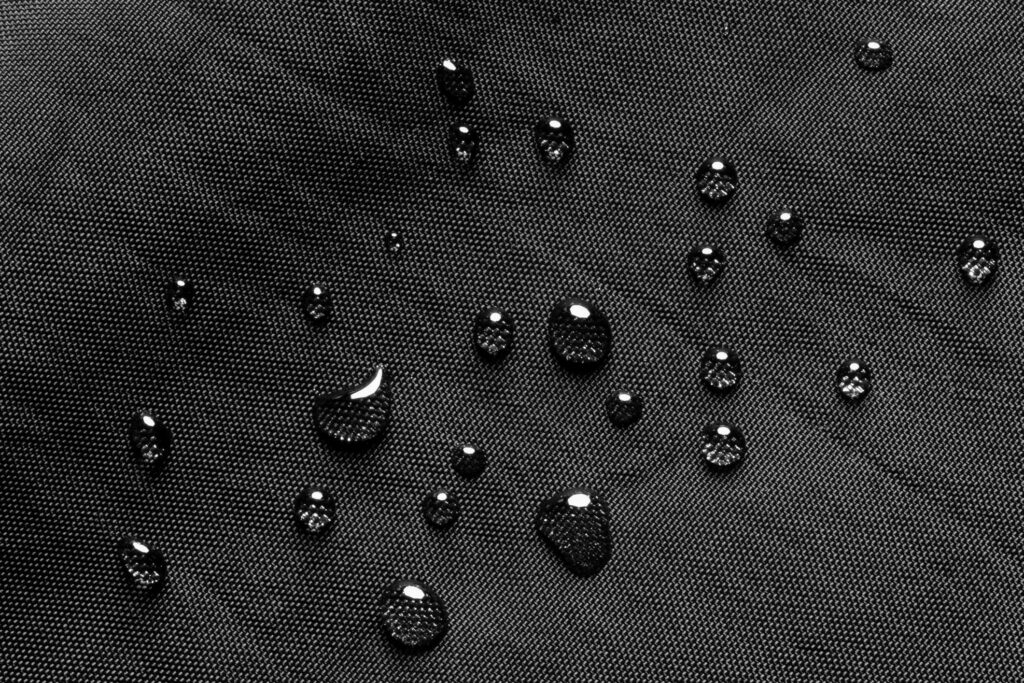
What changed in 2026: because Teflon-type finishes are fluorinated, they are PFAS. They are being phased out of consumer clothing in France, Denmark and several US states (PPE and some professional garments are exempt), and they cannot be used on OEKO-TEX® STANDARD 100 articles. The alternative is a fluorine-free (C0) water repellent, which repels water but not oil.
What Teflon fabric is, and what it is not
“Teflon” shows up in three very different textile products, and searches for “Teflon cloth” or “Teflon coated fabric” often mix them up.
| Product | What it is | Typical use |
|---|---|---|
| Teflon-finished fabric | Ordinary cotton, poly-cotton, nylon/cotton or stretch fabric with a fluorinated repellent finish on the fibres | Workwear, uniforms, trousers, jackets |
| PTFE membrane laminate | A thin microporous PTFE film bonded to a fabric | Waterproof-breathable shells |
| PTFE-coated glass cloth | Fibreglass fabric coated with PTFE | Heat-press sheets, baking liners, conveyor belts. Not garments |
This guide is about the first row: the finish applied to workwear and uniform fabrics.
How the finish works
The finish forms a very thin repellent layer around each fibre. It lowers the surface energy of the fabric, so liquids stay as droplets instead of wetting the cloth. The chemistry decides what gets repelled:
- Teflon-type finishes (fluorinated, C6) repel both water and oils.
- Fluorine-free finishes (C0), usually silicone- or hydrocarbon-based, repel water only.
Neither is waterproof. There is no film or membrane, so a repellent finish handles spills, splashes and light rain, not sustained pressure or heavy rain.
Teflon vs fluorine-free: what we see in production
Typical spray-test results on our workwear fabrics (ISO 4920, 0–100 scale, higher is better; washing at 40°C):
| Teflon™ (fluorinated, C6) | Fluorine-free (C0) | |
|---|---|---|
| Water repellency, before washing | 100 | 90 |
| Water repellency, after washing | 80 after 10 washes | 70 after 5 washes |
| Oil repellency | Yes | No |
| OEKO-TEX® STANDARD 100 articles | Not permitted (PFAS) | Permitted |
Typical results (spray rating per ISO 4920, 40°C wash); they vary with fabric construction, fibre blend, dye shade and wash conditions. We test every development batch before bulk production.
What is Teflon fabric used for?
The finish suits garments that meet spills, dust and everyday soiling more than sustained rain:
- Trade and industrial workwear: cargo pants, trousers and jackets for construction, manufacturing and workshops, where oil- and water-based stains, dust and dry soil are daily problems.
- Hospitality and food-service uniforms: chef and service garments that meet food and drink spills. Oil repellency is where a fluorinated finish differs most from a fluorine-free one.
- Corporate uniforms and work trousers: garments that need to stay presentable between washes.
- Casual and outdoor clothing: everyday trousers and jackets exposed to light rain and splashes.
Which fabrics can carry a Teflon finish?
The finish sits on the fibre surface, so we do not limit it by fibre composition. Both Teflon and fluorine-free finishes can be applied to the main workwear base fabrics:
| Base fabric | Examples | Finish options |
|---|---|---|
| Poly-cotton (T/C) | 65/35 twill, 245gsm, industrial washing + Teflon | Teflon or fluorine-free |
| 100% cotton | Cotton twill and ripstop for work shirts and pants | Teflon or fluorine-free |
| Nylon/cotton | Nylon/cotton work and uniform fabrics | Teflon or fluorine-free |
| Stretch | 65/32/3 poly-cotton-spandex, 245gsm, Teflon; T/C stretch ripstop 235gsm, fluorine-free | Teflon or fluorine-free |
Results still depend on fibre blend, weave density, pre-treatment and dye shade, so we recommend testing the finish on your final fabric rather than relying on figures from a different construction.
Which finish should you specify?
- Selling into the EU or US, or need OEKO-TEX® STANDARD 100: specify fluorine-free. This is the default we now run for European and US customers, and every OEKO-TEX order we take goes on the fluorine-free line.
- The hazard is water-based splashes or spills: fluorine-free is enough. Plan for lower wash retention and agree a spray-rating target after a set number of washes.
- Oil or grease repellency is essential: a Teflon (fluorinated) finish is the only option we have seen that delivers both water and oil repellency well. Check first whether your market, product category and any PPE exemption allow it.
- Garments go through industrial laundering: test against EN ISO 15797 conditions and ask for spray ratings after wash cycles, not only on new fabric.
PFAS rules that affect Teflon-type finishes
Fluorinated repellents are PFAS. These are the main rules we track for workwear and uniform fabrics:
| Region | What applies |
|---|---|
| France | Since 1 Jan 2026, PFAS are banned in clothing textiles, footwear and their waterproofing agents above set residue thresholds (Decree 2025-1376). Protective clothing for safety professionals is exempt. Stock made before 2026 may be sold until 31 Dec 2026. The ban extends to all textiles in 2030. |
| Denmark | From 1 Jul 2026, import and sale of consumer clothing, footwear and waterproofing agents containing PFAS is banned (Executive Order 464). Professional and safety clothing is excluded. Stock may be sold until 1 Jan 2027. |
| EU-wide | The universal PFAS restriction is moving forward: ECHA’s risk committee adopted its opinion on 2 Mar 2026, and the socio-economic committee’s final opinion is expected by end of 2026. It then goes to the European Commission, which prepares the legal proposal, so no EU-wide textile deadline is fixed yet. |
| California | AB 1817 has applied since 1 Jan 2025 to new textile articles with regulated PFAS. PPE is exempt. Outdoor apparel for severe wet conditions follows in 2028. |
| New York | Since 1 Jan 2025, new apparel with intentionally added PFAS cannot be sold; severe-wet outdoor apparel follows in 2028. PPE is not covered. |
| OEKO-TEX® | Intentional use of PFAS is banned on all certified articles, with a total fluorine limit of 100 mg/kg since 2024. The 2026 limit-value update became binding on 1 Jun 2026. |
Exemptions for PPE and professional clothing differ by jurisdiction and product. Confirm scope with your compliance team or test lab for each garment type.
For the updated EN 17681-1:2025 test method and a step-by-step way to switch your range, see our guide Europe Is Banning PFAS in Fabric: What It Means for Workwear Brands.
|
Industry perspective
This year we moved all our European and US orders to fluorine-free finishes. The honest trade-off is that the market has no fluorine-free finish that gives strong water and oil repellency together. In our production, fluorine-free reaches about 90 before washing and about 70 after five washes, while a Teflon finish reaches 100 and about 80 after ten. So the useful conversation with a buyer is not “Teflon or not”. It is which liquid the garment really meets, how many washes it must survive, and which market it will be sold in. — Yu Zhang, Technical Department, Wuhan Prance I&E |
FAQ
Is Teflon fabric waterproof?
No. It is water- and oil-repellent. The finish makes liquid bead and roll off, but there is no membrane or coating, so the fabric will eventually wet through under sustained water or pressure.
Is Teflon fabric the same as the Teflon on non-stick pans?
The brand is the same, the product is not. Non-stick cookware uses a PTFE coating. Teflon-finished fabric uses a repellent finish applied to the fibres, which is why the fabric still feels and breathes like ordinary cloth.
Does Teflon fabric contain PFAS?
Yes. Teflon-type finishes are fluorinated, which places them in the PFAS group. Fluorine-free water repellents are a different chemistry and are not sold as Teflon. Ask your supplier which one is on the fabric and request a test report.
How many washes does the finish last?
In our spray tests (ISO 4920, 40°C wash), a Teflon finish keeps a rating of about 80 after 10 washes and a fluorine-free finish about 70 after 5. Real life depends on the fabric, wash temperature and detergent, so test under your own laundry conditions.
How should I care for Teflon-finished garments?
Wash at up to 40°C, avoid bleach and fabric softener, and dry on low heat. A cool iron or short low-heat tumble can help restore repellency on many finishes.
Which base fabrics can you finish?
Poly-cotton, 100% cotton, nylon/cotton and stretch constructions, with either a Teflon or a fluorine-free finish. We do not limit it by fibre composition. We recommend the finish based on your target market and the hazard the garment faces, then confirm it on your own fabric with a wash test.
|
Need a repellent finish for your workwear range?
Tell us your target market, whether you need oil repellency, and whether the fabric must be OEKO-TEX® certified. We will recommend a finish and send samples with test data. |
Browse our Teflon-finish fabrics, including poly-cotton 245gsm, or our fluorine-free T/C stretch water repellent fabric. For the full picture of wash-durable workwear fabrics, see our guides to industrial washable fabrics for uniforms and sustainable workwear fabrics.
Sources
- UL: France implements major PFAS restrictions
- SGS: Denmark introduces national ban on PFAS in clothing and footwear
- ECHA: update on the REACH restriction on PFAS (June 2026)
- Morgan Lewis: New York and California PFAS bans on textiles and apparel
- Hohenstein: Does OEKO-TEX® allow PFAS in certified products?
- OEKO-TEX®: Limit values, new regulations 2026