
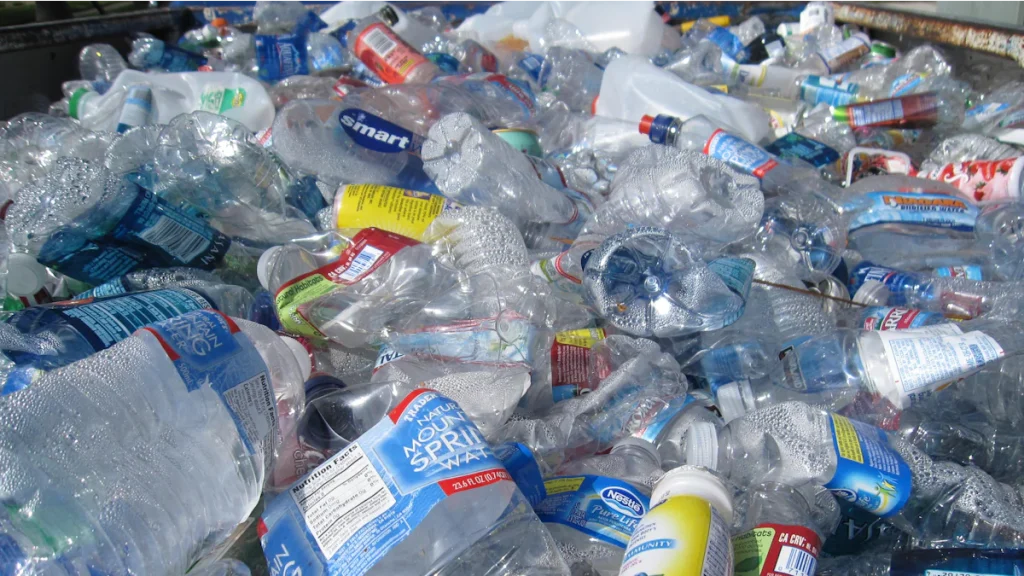
Recycled polyester workwear fabric starts as post-consumer PET bottles, which are cleaned, shredded, melted, and re-spun into fiber. That fiber is spun into yarn, woven into constructions like T/C twill, canvas, or ripstop, then dyed and finished the same way virgin polyester fabric would be. What makes the process verifiable — not just recyclable — is that GRS certification tracks the material at every one of those stages and issues a Transaction Certificate tied to your specific order.
Buyers usually understand recycled polyester in outline, but not in the sequence — which is exactly where the questions come up during supplier evaluation. Here’s what actually happens between “plastic bottle” and “fabric roll,” step by step.
Step 1: From PET Bottle to Fiber
The process starts with post-consumer PET bottles collected through recycling programs. Once sorted, they go through three stages: cleaning to strip labels, caps, and food residue; shredding into small PET flakes; and melting, where the cleaned flakes are heated until they liquefy. The molten PET is extruded through spinnerets — fine nozzles that pull it into continuous filament strands — which are then cooled, stretched, and cut to the fiber length the mill needs. At this point, the material is a recycled polyester staple fiber or filament, functionally equivalent to virgin polyester fiber for spinning purposes.
Step 2: From Fiber to Yarn
Recycled polyester fiber is spun into yarn the same way virgin fiber is — drawn out, twisted, and wound onto bobbins at a target yarn count. For workwear fabric, this stage is where blend ratios get set: recycled polyester fiber is frequently spun together with cotton or organic cotton fiber at this point, rather than blended later, so the resulting yarn already carries the intended fiber composition before weaving even starts.
Step 3: From Yarn to Fabric — Twill, Canvas, or Ripstop
The same recycled polyester/cotton yarn can be woven into several different constructions, and this is usually where a buyer’s actual product spec gets decided:
- T/C twill — a diagonal weave that gives a smoother surface and good drape, common for workwear trousers and shirts
- Canvas — a plain, tightly packed weave that prioritizes weight and abrasion resistance over drape, common for heavier-duty garments
- Ripstop — a base weave with reinforced threads woven in at intervals, forming a grid that stops small tears from spreading
The recycled content doesn’t change which construction makes sense for your product — that decision is still driven by end use. It just means the yarn feeding into the loom is already GRS-tracked.
See: Recycled Polyester/Organic Cotton Stretch Fabric for Trousers
See: Recycled Polyester/Cotton 250gsm Canvas
Step 4: Dyeing and Finishing
Recycled polyester fabric is dyed and finished using the same processes as virgin polyester — disperse dyeing for the polyester component, reactive or vat dyeing for the cotton side of a blend, followed by whatever finish the end product needs (softening, DWR, or an industrial-laundering-resistant finish). The one practical difference worth flagging: recycled polyester fiber can take dye slightly differently than virgin fiber, batch to batch, which is why color consistency checks matter more here than they would on a standard virgin-fiber order — not because the fabric is lower quality, but because the input stream is less uniform than virgin chip.
Industry Perspective
The step buyers underestimate is dye lot consistency, not the recycling process itself. Recycled PET can come from a mixed post-consumer stream, so we run tighter shade checks across a production lot than we would on virgin polyester. It’s a small operational difference, but it’s the one that actually shows up if you skip it.
Step 5: How GRS Keeps Every Stage Traceable
None of the steps above are, on their own, proof that the fiber in your fabric is actually recycled. That’s what GRS certification is for: it requires every facility touching the material — the recycler, the spinner, the weaver, the dye house — to hold its own certification and to document the transfer of certified material at each handoff. If any single link in that chain isn’t certified, the recycled claim breaks there, regardless of what happened upstream.
Step 6: What Documents Buyers Actually Receive
For a GRS order, expect to receive a Transaction Certificate (TC) tied to your specific shipment, stating the fiber composition and certified content percentage, the certified quantity, and the issuing certification body. This is the document that lets you substantiate a recycled content claim to your own customers or auditors — the mill’s general GRS scope certificate isn’t sufficient on its own, since it only confirms the facility is capable of handling certified material, not that your particular order came from it.
📖 Looking for a complete overview? Read our guide: Sustainable Workwear Fabrics