
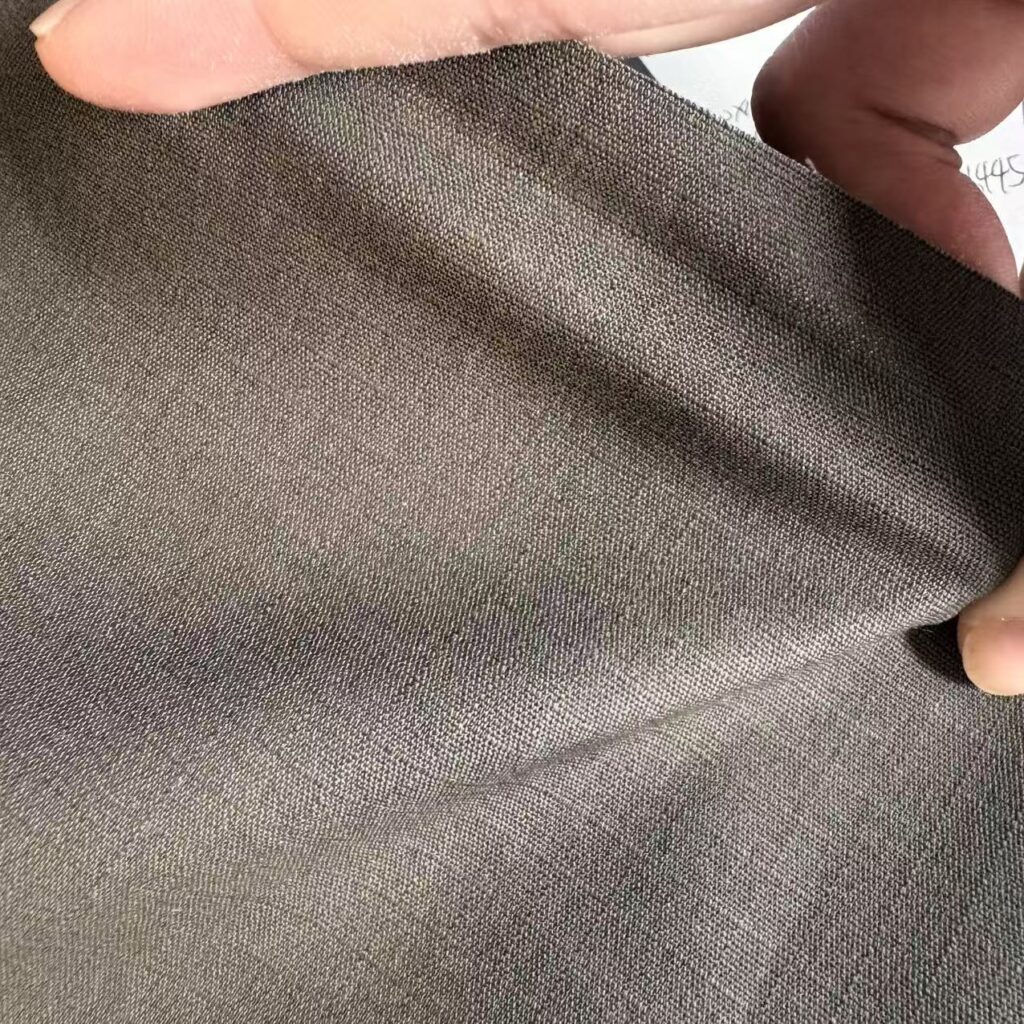
Elastomultiester (EME) is already used in work trousers, high-vis workwear, and industrial uniforms where movement has to be balanced with durability and shape retention. For fabric buyers, the useful question isn’t “Is EME good?” — it’s “Where does it make the most sense for this garment?” The answer changes with the job, the wash cycle, and the weight class. Here are the five applications we see most often, with what to specify for each.
1. Construction and Installation Trousers
Bending, squatting, climbing, kneeling — a rigid weave restricts this movement, and a high-elastane fabric isn’t always ideal under repeated industrial washing. EME fills that gap: stretch and recovery without a separate elastic yarn, so the garment holds its shape wash after wash.
Strauss’s e.s.motion ten trousers — cotton/elastomultiester/polyamide with T400 stretch and knee pad pockets — show this pairing in an actual product.
2. High-Visibility Workwear
High-vis trousers see a full day of walking, climbing, crouching around vehicles and machinery — stretch here is about mobility, not just comfort. Some European high-vis products pair EME-based stretch with reinforced knees and water-repellent finishes.
This split between “stretch fibre” and “safety system” is visible in products like Tranemo’s Hi-Vis Stretch Trousers: the fluorescent stretch fabric (74% polyester / 24% cotton / 2% elastic fibre) handles mobility, while EN ISO 20471 and RIS-3279-TOM certification sit on top of the complete garment, not the fabric’s fibre content alone.
3. Technical Trades Trousers
Electricians, HVAC techs, carpenters need knee-pad pockets, hammer loops, tool pockets, reinforced crotches — the fabric has to stretch under real mechanical stress, not just move.
Bierbaum-Proenen’s BP® work trousers use 78% cotton / 22% EME at 350 g/m² with knee-pad pockets — heavier and more cotton-dominant than the lighter ripstop builds below, proof the right ratio depends on the job.
4. Ripstop Workwear for Automotive, Assembly and Industrial Jobs
Ripstop + EME gives a lighter, still-durable fabric for industry, logistics, and assembly work — better mobility without just adding weight.
| Construction | Detail |
|---|---|
| Code | TL-EME2503 |
| Composition | 43% Polyester / 23% Cotton / 34% EME |
| Weave / Weight | 3×3 Ripstop, 210 g/m² |
| Elongation | 15.7%, high-temp washable |
We also build a 40% cotton / 30% polyester / 30% Lycra® T400® twill (~195 g/m²) — same EME-type fibre, different weight bracket. For summer weight, 170–220 g/m² ripstop is the better starting point. U-Power’s Hike trousers use the same ripstop-plus-stretch logic to stay light and mobile.
5. Frequently-Washed Workwear Programmes
Industrial workwear gets washed often, so recovery after washing matters more than initial stretch %. This is exactly why EME/T400-type fibres get used here — for maintenance, manufacturing, rental workwear, and service uniforms.
Payper’s NEXT 400 line (20% elastomultiester) is built and marketed specifically around high-temp washing without shape loss.
No Single “EME Fabric” — Match It to the Garment
| Application | Fabric direction | What matters most |
|---|---|---|
| Construction trousers | Twill / canvas | Mobility + durability |
| High-vis workwear | Stretch woven / ripstop | Mobility + safety system |
| Trade trousers | Heavy twill / canvas | Stretch + abrasion + reinforcement |
| Lightweight industrial | Ripstop | Weight + tear resistance |
| Laundry programmes | Twill / ripstop | Recovery + dimensional stability |
“We need EME fabric” isn’t enough for a mill to act on. Better: “210–230 gsm polyester/cotton EME ripstop, summer work trousers, 14–17% elongation, repeated industrial washing.”
Most confusion from overseas buyers isn’t about whether EME “works” — it’s asking for EME without specifying the garment first. Once we know summer trouser vs. heavy-duty trade trouser, the construction and blend almost choose themselves.
Five Questions Before You Specify
1. What garment? Trousers, shorts, jackets, coveralls all stretch differently.
2. How much stretch, really? Controlled stretch + good recovery usually beats maximum elasticity.
3. What’s the wash process? Test recovery and dimensional stability after washing, not just before.
4. Extra functions needed? Water/oil repellency, anti-static, ripstop, recycled content — design around the garment.
5. Certification required? EME ≠ protective by itself. Certification (e.g. EN ISO 13688, EN ISO 20471) applies to the finished garment system.
A 170 gsm ripstop EME fabric for summer trousers solves a different problem than a 250 gsm EME fabric for heavy-duty trousers. Define the garment, environment, weight, stretch, and wash conditions first — then pick the construction.
Comparing EME with T400, Sorona, spandex, or mechanical stretch?
Send your target garment, weight, composition, and wash requirements — we’ll recommend a construction and share samples.
FAQ
See our guide to Stretch Workwear Fabrics for other stretch technologies, or learn more about the fibre in EME Stretch Fiber for Workwear.