
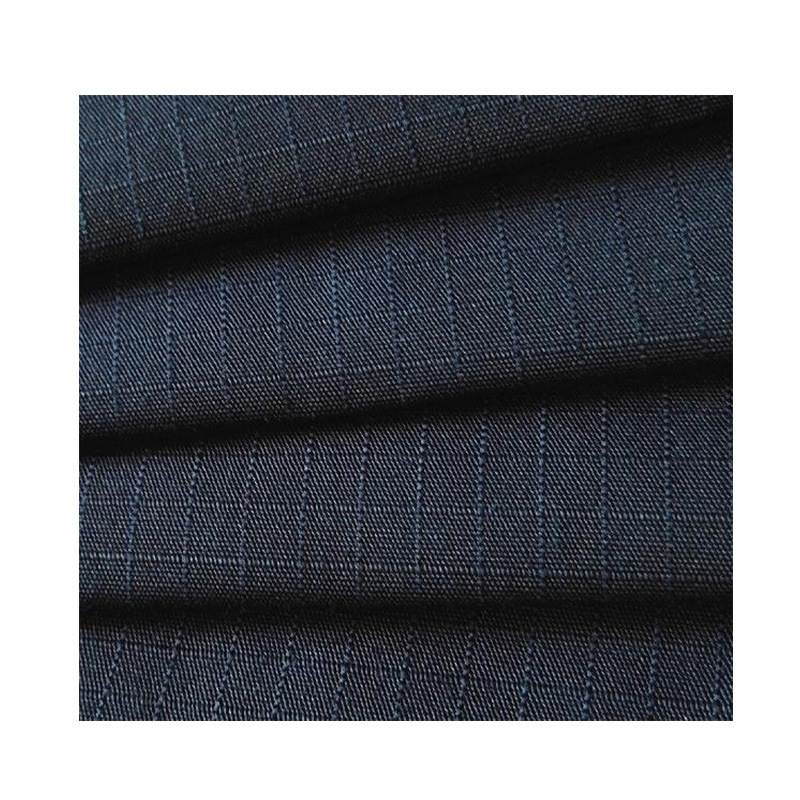
Direct answer: A heavier ripstop fabric is not automatically the stronger one. In one production comparison, a 220gsm T/C 65/35 fabric recorded a higher weft tensile force (1,028 N) and weft tear force (77 N) than a 260gsm fabric from the same construction family (716 N and 44 N). The difference came down to yarn selection and construction — not fabric weight.
These are three real production cases we discuss with workwear brands, garment manufacturers, and sourcing teams who ask us to explain a ripstop specification sheet rather than just quote a GSM number.
Three T/C 65/35 Ripstop Fabrics: Actual Test Results
All three fabrics share the same T/C 65/35 composition and ripstop construction. Their yarn counts, densities, and lab results differ.
| Specification / Test Result | Fabric 1 | Fabric 2 | Fabric 3 |
|---|---|---|---|
| Fabric weight | 220gsm | 260gsm | 280gsm |
| Composition | T/C 65/35 | T/C 65/35 | T/C 65/35 |
| Yarn count spec* | 20 × 16 | 16 × 16 | 16 × 12 |
| Density spec* | 108 × 56 | 108 × 52 | 104 × 50 |
| Tensile force — warp | 1,690 N | 1,819 N | 1,718 N |
| Tensile force — weft | 1,028 N | 716 N | 1,055 N |
| Tear force — warp | 85 N | 88 N | 98 N |
| Tear force — weft | 77 N | 44 N | 116 N |
*Construction figures reproduced as recorded in production specs; count system and density units not specified. Tensile: ISO 13934-1 (strip method). Tear: ISO 13937-1 (pendulum/Elmendorf method).
|
Tensile test (ISO 13934-1) Measures maximum force during a strip tensile test. Buyers often call this “tensile strength,” but the reported figure is a force value, in newtons. |
Tear test (ISO 13937-1) Measures the force needed to propagate a tear from an existing cut, using the ballistic pendulum (Elmendorf) method — a different mechanical response from tensile testing. |
A fabric can lead one measurement without leading another — as these results show.
Why Did the 260gsm Fabric Have Lower Weft Strength?
Fabric 2 was 18.2% heavier than Fabric 1, but its weft results were substantially lower:
▼ Weft tensile force: 30.4% lower — 1,028 N → 716 N
▼ Weft tear force: 42.9% lower — 77 N → 44 N
GSM alone would not reveal this. But calling the 260gsm fabric simply “weaker” misses part of the picture too:
▲ Warp tensile force increased — 1,690 N → 1,819 N
▲ Warp tear force increased — 85 N → 88 N
The Weft Yarn Was an Intentional Cost Decision
Fabric 1 used ring-spun yarn throughout. For Fabric 2, we selected open-end spun yarn in the weft — a deliberate choice. The customer had a strict cost target and no particularly demanding weft-strength requirement, so the yarn combination balanced those two priorities.
Fabric development is not always an exercise in maximizing every test result. A buyer needs a construction suited to the garment’s requirements and target price. For a project with a demanding weft-strength requirement, the same selection could be the wrong call — which is why the performance brief has to come before the yarn decision, not after it.
In this case, the weft yarn was one contributing factor in the lower weft results. It should not be read as a general claim that open-end yarn always produces weaker fabric.
Spinning Method Was Not the Only Variable
The two fabrics also carried different construction specifications:
| Yarn count | Density | |
|---|---|---|
| Fabric 1 | 20 × 16 | 108 × 56 |
| Fabric 2 | 16 × 16 | 108 × 52 |
These were different production fabrics, not a controlled trial isolating spinning method as the only variable. Research comparing open-end and ring-spun woven fabrics shows yarn structure can influence behavior such as crimp and tearing performance, but it does not tell us how much of the difference in our samples came from that factor alone (Mohamed and Lord, Comparison of Physical Properties of Fabrics Woven from Open-End and Ring Spun Yarns).
Our practical conclusion is narrower: buyers should understand the yarn specification behind a quoted GSM, especially when comparing fabrics built for different cost targets.
The 280gsm Fabric Changes the Ranking Again
Fabric 3 recorded the highest tear force in both directions — 98 N warp, 116 N weft — roughly 2.64× the 260gsm fabric’s weft tear result. It also led weft tensile force at 1,055 N. But it did not lead every measurement: its warp tensile force, 1,718 N, was 5.6% below Fabric 2’s 1,819 N.
| Measurement | Highest result among these samples |
|---|---|
| Warp tensile force | 260gsm — 1,819 N |
| Weft tensile force | 280gsm — 1,055 N |
| Warp tear force | 280gsm — 98 N |
| Weft tear force | 280gsm — 116 N |
The heaviest sample won three of four measurements — but weight alone didn’t predict all four, and a numerical gap shouldn’t be treated as statistically significant without variability data.
What Matters Besides GSM?
GSM tells a buyer how much a square metre of fabric weighs. To understand strength, we need to examine how that fabric was built.
|
Yarn count and actual yarn properties. A construction spec lists yarn counts, but counts alone don’t describe yarn quality. Spinning method matters too — as the 260gsm case shows. |
|
Warp and weft density. The three fabrics used different density specs. Effects can’t be reduced to “more threads always means greater strength” — under tearing, yarn movement and grouping affect how load is shared. |
|
Base weave and ripstop arrangement. “Ripstop” doesn’t describe every structural detail. Understanding the reinforcement layout and yarn interaction explains why fabrics with the same construction label can behave differently. Research on woven-fabric tearing treats yarn linear density, thread density, and weave as interacting variables — not a formula for predicting these three test results (Tear Resistance of Woven Textiles — Criterion and Mechanisms). |
|
Processing and test conditions. Finishing and laundering history should be established for any tested sample. Those details aren’t supplied in this comparison, so we don’t assign the observed differences to a particular finish. |
The point is to connect the test result to an identifiable fabric specification — not to a weight number on its own.
What Buyers Should Ask a Supplier Besides GSM
A useful sourcing brief starts with the garment and its likely demands — work trousers exposed to snags, repeated kneeling, or stress around pockets may need different evaluations. When comparing ripstop quotations, ask:
| 1 | What are the tensile and tear results in both directions? Request the figures separately rather than accepting a general “high-strength” description. |
| 2 | Which methods and test conditions were used? Check the standard, units, sample condition, and report reference — results from different tear methods aren’t directly interchangeable. |
| 3 | What yarn and construction specifications support those results? Confirm counts and units, warp/weft density, spinning method, and ripstop arrangement. |
| 4 | What performance requirement is driving the selection? Agree the required results and target cost — Fabric 2 shows how much that discussion can affect yarn choice. |
| 5 | What else needs validation before bulk approval? Tensile and tear figures don’t establish abrasion resistance, seam performance, comfort, or post-laundering durability — include the evaluations relevant to the finished garment. |
These are three production cases with reported results, not a complete experimental dataset — sample counts, variability, and full testing conditions are not presented here. The results should not be treated as guaranteed minimum values for future production.
Industry Perspective
Do not judge ripstop fabric strength by GSM alone. Agree the required performance up front, understand the construction behind the number, and validate the proposed fabric against the buyer’s actual brief.
— Fabric Development & Export, Wuhan Prance I&E
FAQ
Does a higher GSM ripstop fabric always tear or pull apart at a higher force?
No. In this comparison, a 220gsm fabric outperformed a 260gsm fabric on weft tensile and weft tear force. Yarn selection and construction, not weight, drove the difference.
What’s the difference between tensile force and tear force?
Tensile force (ISO 13934-1) is the maximum force recorded pulling an intact strip apart. Tear force (ISO 13937-1) measures the force needed to propagate a tear from an existing cut using the pendulum method — a different mechanical response.
Is open-end spun yarn always weaker than ring-spun yarn?
Not as a general rule. In this case it was one contributing factor to lower weft results in a fabric built to a specific cost target — not evidence that open-end yarn is inherently inferior.
What should I request from a supplier besides a GSM figure?
Directional tensile and tear results, the test standards used, the yarn count and density specification, the spinning method, and the ripstop weave arrangement.
Need help reading a ripstop fabric spec sheet?
Send us your performance brief and target cost, and we’ll help you match the construction to the requirement.
Learn more on our Ripstop Fabric pillar page.