
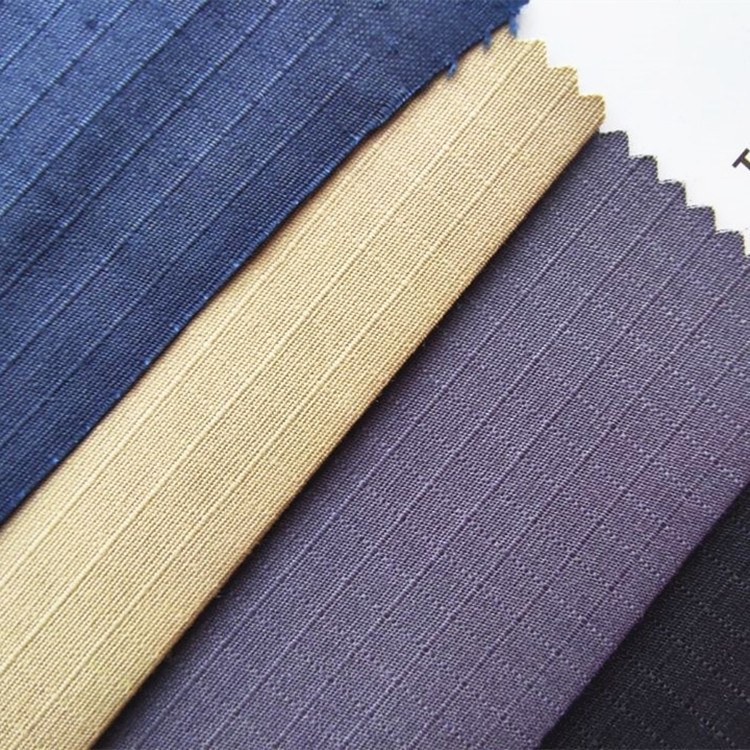
When buyers ask for “tear resistant fabric” for workwear pants, many people immediately think of ripstop fabric.
But in real production and real wearing conditions, tear resistant does not automatically mean ripstop.
This is one of the most common misunderstandings we see from buyers, especially in construction workwear projects.
As a fabric supplier working with European workwear brands, we often need to explain what actually affects tear resistance — and what doesn’t.
Tear Resistant ≠ Always Ripstop
Ripstop fabric is easy to recognize.
It has a visible grid structure made by thicker reinforcement yarns.
Yes, ripstop can improve tear resistance — but only under the right conditions.
In reality:
- Some ripstop fabrics tear easily
- Some non-ripstop twill or canvas fabrics perform better in tear tests
Why? Because ripstop is only one factor, not the final answer.
What Really Affects Tear Resistance?
1. Fabric Weight (GSM)
For construction work pants, fabric weight matters a lot.
In most cases:
- Below 220 gsm → limited tear resistance
- 240–300 gsm → much more stable for heavy work use
A light ripstop fabric will not outperform a heavier, well-constructed twill just because it has a grid.
Weight gives the fabric material to resist force.
2. Fabric Structure (Weave)
Different weaves behave very differently when force is applied.
-
Ripstop
- Stops tearing once the rip reaches the grid
- But the space between grids can still tear easily if yarns are weak
-
Twill / Canvas
- More continuous structure
- Often performs better in real wear, friction, and repeated stress areas
- Especially suitable for knees, seat, and thigh areas of work pants
For construction workwear, overall structure stability is often more important than tear-stop points.
3. Yarn Type and Yarn Strength
This part is often ignored.
Two fabrics with the same gsm and weave can have very different tear strength, because of:
- Yarn count
- Fiber quality
- Spinning method
For example:
- Low-quality short staple yarn → easier to break
- Stronger polyester or blended yarn → much higher tear resistance
This is why lab test results can be very different even if fabrics “look similar”.
Common Fabric Choices for Construction Work Pants
In real projects, we often see these combinations work best:
-
Polyester / Cotton Twill or Canvas (240–300 gsm)
Stable, durable, cost-controlled, widely used -
Stretch Poly/Cotton (with elastic fiber, not basic spandex)
Better comfort with controlled tear strength
More suitable when industrial laundry is involved -
Mid- to Heavy-Weight Stretch Ripstop
A good balance when tear resistance and mobility are both required
Fabric structure and yarn quality must be carefully designed
Ripstop works well only when it is properly engineered, not just added as a pattern.
A Simple Tip for Buyers
Instead of asking only:
“Is this fabric tear resistant?”
It is much more useful to ask:
- What is the tear strength test result?
- What is the fabric weight and weave?
- What is the actual wearing environment (construction site, kneeling, friction, industrial laundry)?
For tender or long-term projects, we often suggest a small trial run before full production.
Final Thought
Ripstop is a tool, not a guarantee.
True tear resistance comes from the right combination of fabric weight, structure, yarn quality, and real usage conditions.
Understanding this helps buyers avoid wrong fabric choices — and helps workwear brands build pants that perform well on real jobsites, not just in specifications.