
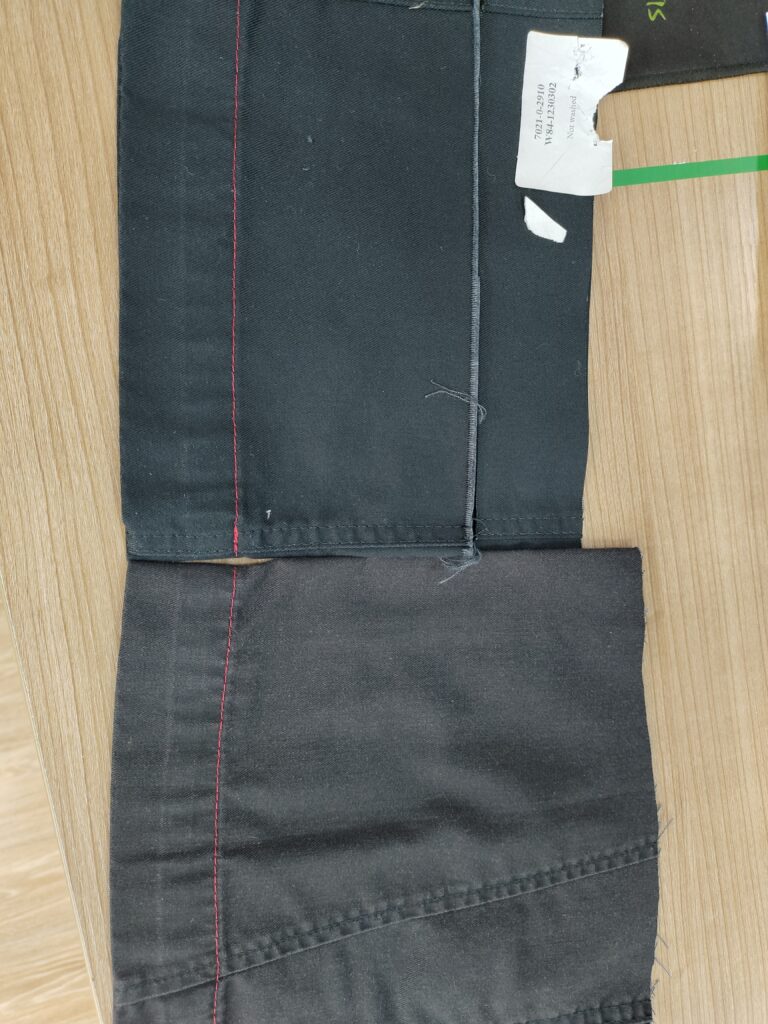
You followed every step—approved lab dips, confirmed bulk samples, and passed fabric testing. Everything looked perfect. Yet, after selling the garments, customer complaints start coming in: fading, pilling, color bleeding. So what went wrong? The issue may not be your supplier—but your testing logic.
Passing a fabric test does not guarantee real-life performance. Most fabric tests, such as ISO color fastness tests, simulate limited conditions like a single wash at 40°C. However, real-world use involves repeated washing, higher temperatures, friction, and harsh detergents. This gap between lab testing and actual wearing conditions is the main reason why fabrics that pass testing can still fail in the hands of end users.
Let me share a few real cases from our work with workwear brands in Europe and the US.
Why did my fabric pass testing but still get customer complaints?
In most cases, the process looks like this: you approve quality samples, color swatches, and hand feel. Then bulk production is completed, and a few meters are sent for third-party fabric testing, such as a color fastness test. Results come back compliant. You pay the balance, receive the goods, and start production.
Everything is “correct”.
But real users don’t live in laboratory conditions. And that’s where problems begin.
The gap between lab testing and real-life wearing conditions
The biggest issue in garment testing challenges is this: lab tests are controlled, but real life is not.
First, most tests simulate limited cycles. For example, ISO 105 color fastness testing often uses a single wash at 40°C. But in reality, garments—especially workwear—are washed dozens of times.
Second, lab tests isolate variables. Real usage combines many factors:
- Higher washing temperatures
- Industrial detergents (sometimes containing chlorine or oxidizing agents)
- Mechanical friction from wearing and washing
Third, testing standards are minimum benchmarks, not guarantees of performance.
This is why I always tell my clients:
There is no best fabric—only the most suitable fabric for your actual use conditions.
Case 1: Good color fastness test, but fading after 5 washes
One of our clients ordered several thousand meters of fabric for work pants. The fabric passed the standard fabric color fastness test (ISO 105), with washing at 40°C showing good results.
However, after selling the garments, complaints started coming in.
Customers reported that after just 4–5 washes, the fabric—especially in navy, black, and green—started fading significantly.
We investigated further:
- How many times were the garments washed?
- At what temperature?
- What kind of detergent was used?
The answer was clear: real usage conditions were much harsher than the test conditions.
To solve this fabric quality issue in clothing, we worked with the client to upgrade the dyeing process:
- Switching from reactive dyes to vat dyes
- Using chlorine-resistant dyes
- Improving resistance to high-temperature washing (up to 95°C)
- Adapting to industrial washing conditions (60–75°C, 50 cycles)
After these changes, customer complaints dropped significantly.
Case 2: EN ISO 20471 passed, but reflective tape got stained
In another case, we supplied high-visibility orange fabric for safety garments. The fabric passed full EN ISO 20471 testing at SGS, including color fastness after 5 washes at 60°C, achieving grade 4–5.
Everything looked perfect on paper.
But in real use, customers reported that after washing, the reflective tape became stained with orange dye and appeared darker—affecting visibility.
We conducted comparison tests and consulted multiple reflective tape suppliers. The root cause was finally identified:
👉 The reflective tape lacked an anti-sublimation backing.
Without this layer, dye migration (especially under heat and washing conditions) caused staining.
The solution was simple but critical:
Use reflective tape with anti-sublimation treatment, which effectively prevents color transfer.
How to choose the right fabric for real workwear conditions
If your target market is Europe or the US, especially for workwear, you must think beyond standard textile color fastness ISO 105 tests.
Start with the real scenario:
- Who will wear the garment?
- How often will it be washed?
- Will it undergo industrial washing?
- What kind of detergents will be used?
Workwear is exposed to:
- Frequent washing
- High temperatures
- Strong chemicals
- Continuous friction
So instead of asking:
Did the fabric pass the test?
You should ask:
Is this fabric designed for my actual use conditions?
At Wuhan Prance I&E Co., Ltd, we specialize in mid-to-high-end workwear fabrics for demanding environments. We help our clients not just pass tests—but succeed in real-world performance.
If you are facing similar issues or want to prevent costly mistakes in bulk orders, feel free to reach out:
📩 sales@ripstopfabric.com
Summary
Fabric testing is important—but it is not enough. Real performance depends on how the fabric is actually used. To avoid customer complaints, always match your fabric specifications with real-life wearing conditions, not just laboratory standards.